

Issues associated with the prostate in men are quite common and mostly prevalent among men as they become older. The prostate is a small organ found in the body of men that is situated just below the bladder of men and encircles the top portion of the urethra, the tube through which the urine passes out of the body of men. The prostate plays a vital part in the reproductive system of men, as it produces fluids that form a component of the semen in men.
Are you suffering from increased urination frequency, a problem in urination, or frequent visits to the toilet during the night? These may be symptoms of prostate issues in men. There are some prostate diseases that take time to develop, so their symptoms go unnoticed for a long time.
What Are the Common Prostate Issues That Afflict Men?
What kinds of prostate issues are there in men? There are various types of prostate diseases in men, with each being caused by different factors and manifesting through different symptoms.
The common prostate diseases are:
1. Benign Prostatic Hyperplasia (BPH): It refers to non-cancerous enlargement of the prostate glands, which tends to occur in older men. It results in compression of the urethra causing changes in urine flow.
2. Prostatitis: It entails inflammation or infection of the prostate glands. It manifests with symptoms like pelvic pain, difficulty in passing urine and fever.
3. Prostate Cancer: It entails the formation of tumors of abnormal cells in the prostate glands. Prostate cancer in its early stages does not exhibit any symptoms at all.
Visit the Urology Department at Continental Hospitals, Hyderabad, for expert care and advanced urological services.
What Are the Early Signs of Prostate Issues in Men?
How do you know when there are early signs of prostate issues? There are some changes in urination that will signal this. Nonetheless, it depends on what kind of prostate issue one is dealing with.

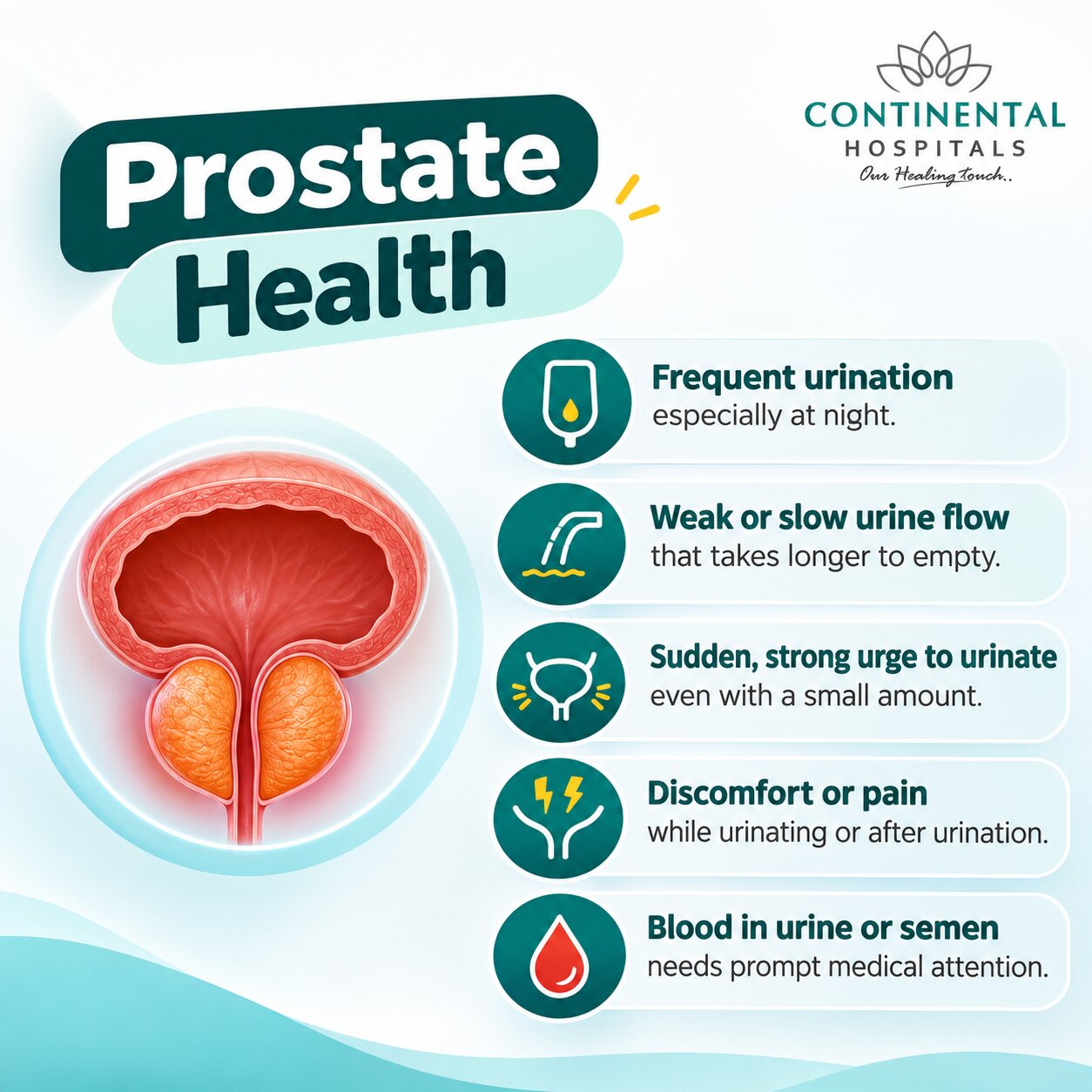
Here are the symptoms you should look out for:
1. Frequent urination: Experiencing the urge to urinate more frequently, especially at night.
2. Weak urine stream: When the urine comes in slowly and with less pressure than usual.
3. Urination hesitancy: There is a delay when it comes to the beginning of urination.
4. Urinary retention: There is an urge to continue urinating because of the feeling that your bladder is still full.
5. Urgency: An urgent need to pass urine.
6. Urination pain: Itching or burning sensations during urination.
7. Blood in urine: Discoloration of the urine, which appears pink, red, or brown.
8. Pelvic pain: The pain occurs in the lower abdomen, groin, lower back, or area between the scrotum and anus.
These symptoms shouldn’t be overlooked.
What Are The Factors Leading To Prostate Disorders In Men?
Why do problems with the prostate occur? Some factors may increase the chances of developing the disease.
The following are some common factors that lead to the development of prostate problems:
- Aging: The older a person is, the higher his chances of developing an enlarged prostate or any other prostate disorder.
- Hormonal changes: These changes may cause an enlarged prostate.
- Genetics: The presence of family members suffering from prostate disorders, especially prostate cancer, increases one's chances of getting the disease.
- Inflammation/infections: In some cases, certain infections may cause prostatitis.
- Living styles: Obesity and lack of physical exercise are factors that may lead to certain prostate disorders.
Diagnosis of Prostate Problem
How does the doctor determine a prostate problem in men? In order to diagnose the patient, a discussion will be held regarding his symptoms, medical background and history.
Based on the needs of the patient, the urologist can request:
- Digital Rectal Examination (DRE): Physical assessment of the prostate’s size and condition.
- PSA Test: Measurement of the prostate-specific antigen level in the blood. A high PSA level does not automatically mean cancer.
- Urinalysis: Used for detection of urinary infection or other abnormalities.
- Ultrasound: For assessment of the prostate, bladder, and urinary tract.
- Further testing: MRI or biopsy of the prostate when necessary.
When Should Men See a Doctor?
When should you visit a doctor about your prostate? Unusual urine issues need a doctor's help, despite the fact that they are not painful.
Visit a urologist if you have any of these symptoms:
- Often need to urinate, especially at night.
- Difficulty initiating or holding urination.
- Pain in your pelvis or lower abdomen.
- Pain while urinating or having sex.
- Presence of blood in your urine or sperm.
- Recurrent urinary tract infections.
Note: When you have trouble urinating, see your doctor immediately. It might be a case of acute retention of urine.
Why Should You Prefer Continental Hospitals for Prostate?
What makes the choice of the correct hospital for treatment essential? It should be noted that prostate diseases may have common symptoms; however, they demand different approaches to treatment. The presence of experienced doctors, proper diagnostic facilities, and a treatment plan is significant.
It should be noted that Continental Hospitals, Hyderabad, provides the patients with all types of urological services, as well as experienced specialists, modern diagnostic facilities, up-to-date medical facilities, and multidisciplinary knowledge.
The facility is accredited both nationally and internationally in such organizations as the Joint Commission International (JCI) and the National Accreditation Board for Hospitals and Healthcare Providers (NABH).
Being one of the best hospitals in Hyderabad, Continental Hospitals pays much attention to the patient-centered approach in the process of diagnosis and treatment of prostate and other related diseases.
Conclusion
There are various issues related to the prostate gland in males that can have an impact on both urinary and reproductive systems along with daily routine activities of a person. Some common issues like enlarged prostate, prostatitis, and prostate cancer may have various symptoms. Thus, the diagnosis of these symptoms can play an essential role in detecting the disease and providing suitable treatment options for the same.
If you have issues like frequent urination, poor urine flow, difficulty in urination, pelvic pain, or any other sign of prostate diseases, consult our best urologist in Hyderabad at Continental Hospitals, Hyderabad.
Related Blogs: