.webp)


Your eyes are often called the windows to your soul, but in the world of medicine, they are more like the windows to your overall health. Many people dismiss slight changes in their vision as a sign of fatigue or aging. However, certain eye symptoms can be early warning signs of serious conditions that, if left untreated, could lead to permanent vision loss or indicate underlying systemic issues.
Understanding which eye symptoms require immediate attention is the first step in preserving your sight. This guide explores the critical warning signs you should never overlook and why timely intervention is essential for long-term eye health.
Sudden Changes in Vision
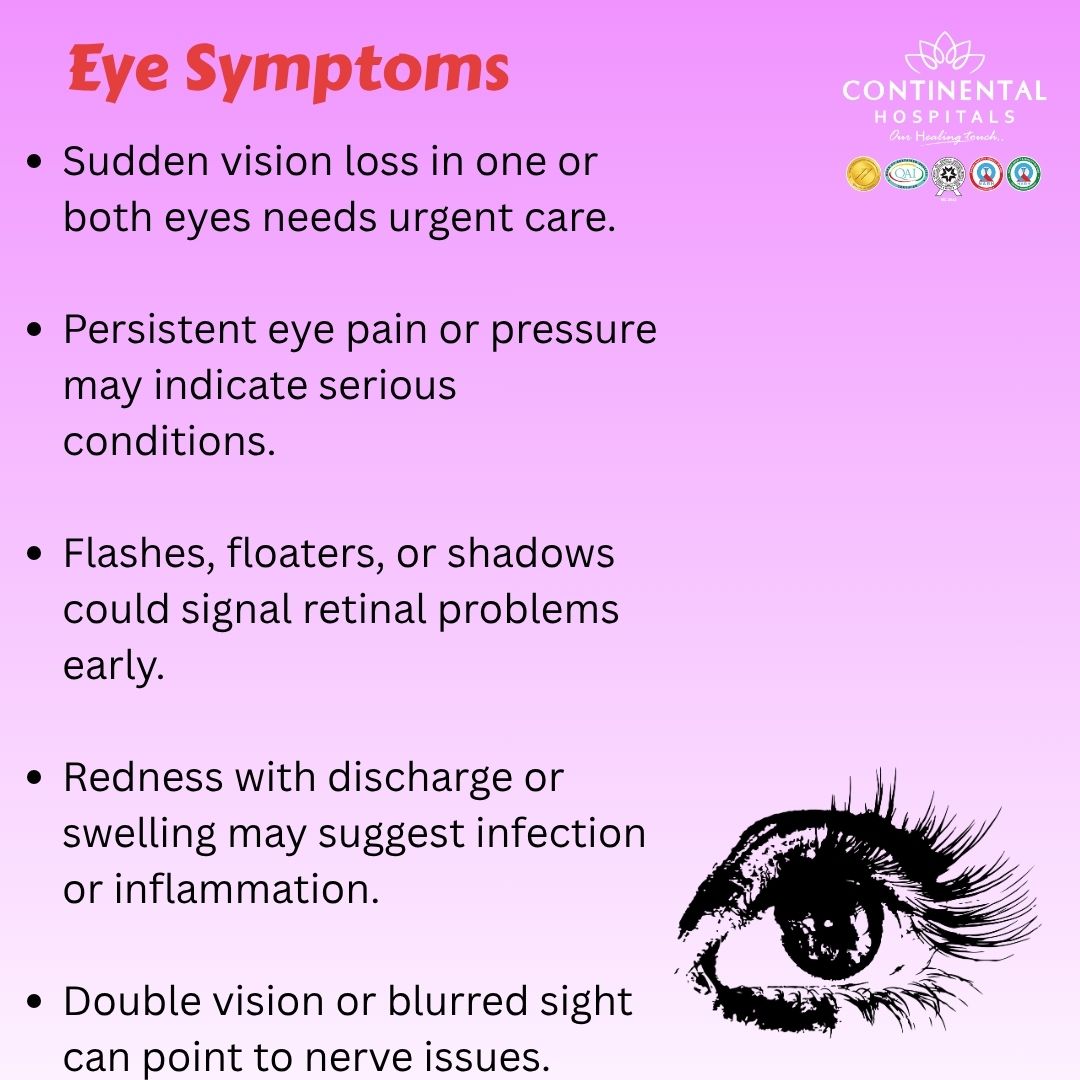
One of the most alarming eye symptoms is a sudden change in how you see. If you experience a blurred patch in your central vision or if your peripheral vision seems to be closing in, you must seek medical help immediately. Sudden blurriness or a "curtain" falling over your field of vision can be a sign of a retinal detachment.
The retina is a thin layer of tissue at the back of the eye that processes light. If it pulls away from its normal position, it loses its blood supply. This is a medical emergency. Without rapid treatment, a detached retina can cause permanent blindness in the affected eye.
If you notice persistent vision changes or discomfort, don’t delay. Visit our Medical Ophthalmology Department or book an appointment with our expert ophthalmologists at Continental Hospitals today.
The Appearance of Floaters and Flashes
Most people have seen tiny specks or "cobwebs" drifting across their field of vision at some point. These are known as floaters. While a few occasional floaters are usually harmless, a sudden increase in their number is one of the major eye symptoms linked to retinal issues.
If these floaters are accompanied by flashes of light, similar to seeing stars or lightning bolts, it suggests that something is tugging on the retina. Monitoring these eye health warning signs can be the difference between a simple laser procedure and complex surgery.
Persistent Eye Pain
While minor irritation from dust or dry air is common, deep, throbbing, or persistent eye pain is never normal. Pain that feels like it is coming from inside the eye can indicate several serious conditions:

Glaucoma: Specifically, acute angle-closure glaucoma can cause sudden, intense pain, nausea, and redness. This condition involves a rapid increase in eye pressure.
Uveitis: This is an inflammation of the middle layer of the eye. It often causes pain and sensitivity to light.
Corneal Ulcers: An infection on the clear front surface of the eye can cause significant discomfort and requires urgent antibiotic or antifungal treatment.
Redness That Does Not Resolve
Red eyes are often associated with lack of sleep or allergies. However, if the redness is accompanied by pain, discharge, or a change in vision, it moves from a minor inconvenience to one of the serious eye symptoms.
Persistent redness may indicate an infection or an inflammatory condition. It can also be a sign of conjunctivitis, which is highly contagious, or more severe issues like scleritis. Protecting your eye health means investigating redness that lasts more than a day or two.
Sensitivity to Light (Photophobia)
If normal indoor lighting or a bright sunny day suddenly becomes unbearable, your eyes are sending you a signal. Light sensitivity can be linked to infections, corneal abrasions, or even migraines. In more serious cases, it is one of the eye symptoms associated with internal eye inflammation. If you find yourself squinting or needing sunglasses indoors, it is time for a professional evaluation.
Difficulty Seeing at Night
Have you noticed that driving at night is becoming more difficult? If streetlights look blurry or if you struggle to see objects in low light, this could be an early sign of cataracts. Cataracts occur when the natural lens of the eye becomes cloudy. While they develop slowly, identifying these eye health warning signs early allows for better planning and management of your vision.
Key Eye Health Tips for Every Day
Maintaining your vision requires proactive care. Here are some essential eye health tips to incorporate into your lifestyle:
Follow the 20-20-20 Rule: Every 20 minutes, look at something 20 feet away for at least 20 seconds to reduce digital eye strain.
Wear UV Protection: Always wear sunglasses that block 100% of UVA and UVB rays when outdoors to prevent sun damage to your lenses and retinas.
Schedule Regular Exams: Many eye diseases, such as open-angle glaucoma, have no early eye symptoms. Only a comprehensive eye exam can detect them.
Maintain Healthy Blood Sugar: High blood sugar can damage the tiny blood vessels in the retina, leading to diabetic retinopathy.
Quit Smoking: Smoking increases the risk of age-related macular degeneration and cataracts.
Why Choose Continental Hospitals for Eye Care?
When it comes to your vision, you deserve care from a facility that combines clinical excellence with advanced technology. Continental Hospitals is recognized as the best hospital in Hyderabad for its comprehensive approach to multi-specialty care.
Our facility is designed to provide a global standard of healthcare right here in Hyderabad. We understand that eye symptoms can be stressful, and our team is dedicated to providing accurate diagnoses and effective treatments in a compassionate environment.
Our Accreditations and Standards
Quality and safety are the pillars of our service. Continental Hospitals is proud to hold prestigious accreditations that reflect our commitment to patient care:
JCI Accreditation: We adhere to the rigorous standards of the Joint Commission International, ensuring that our clinical processes meet global benchmarks.
NABH Accreditation: Our facility is accredited by the National Accreditation Board for Hospitals & Healthcare Providers, which is the highest national recognition for quality in India.
Advanced Technology: We utilize the latest diagnostic tools to identify subtle eye health warning signs before they escalate into major problems.
By choosing Continental Hospitals, you are opting for a facility where every protocol is designed with patient safety and recovery in mind. Our specialists work across departments to ensure that if your eye symptoms are related to other health issues like diabetes or hypertension, you receive holistic care.
Conclusion
Ignoring changes in your vision is a risk you cannot afford to take. Whether it is a sudden flash of light, persistent redness, or a gradual decline in night vision, these eye symptoms are your body’s way of asking for help. Early detection is the most powerful tool in ophthalmology. Most conditions that lead to vision loss can be managed or cured if caught in time.
Your sight is precious. By staying informed about warning signs of eye problems and maintaining a relationship with a trusted healthcare provider, you can enjoy clear vision for years to come. Do not wait for a minor irritation to become a major crisis.
If you are experiencing any of the symptoms mentioned above, or if it has been a long time since your last check-up, reach out to a professional.
If you suffer from any persistent vision changes or discomfort, consult our experts today. Book an appointment with our best ophthalmologist in Hyderabad at Continental Hospitals.
Related Blog Topics: