.webp)

Extracorporeal Membrane Oxygenation, also called ECMO, is a life saving treatment used for patients with severe heart or lung failure. While ECMO provides critical support, it also involves tubes, catheters, and machines that stay connected to the patient for several days. Because of this, hospitals must follow extremely strict ECMO infection control measures to prevent infections and keep patients safe.
What Makes ECMO Patients More Prone to Infection?
ECMO treatment involves catheters inserted into major blood vessels. These catheters act as a doorway for germs when safety measures are not followed correctly. Some major ECMO related infection risks include:
- Catheter site infections due to long duration of cannulation.
- Bloodstream infections when bacteria enter through tubing.
- Ventilator associated infections because ECMO is often used with a ventilator.
- ICU environment exposure when hygiene standards are not followed.
Because of these risks, hospitals focus strongly on ECMO catheter infection control and advanced protocols to prevent ECMO complications.
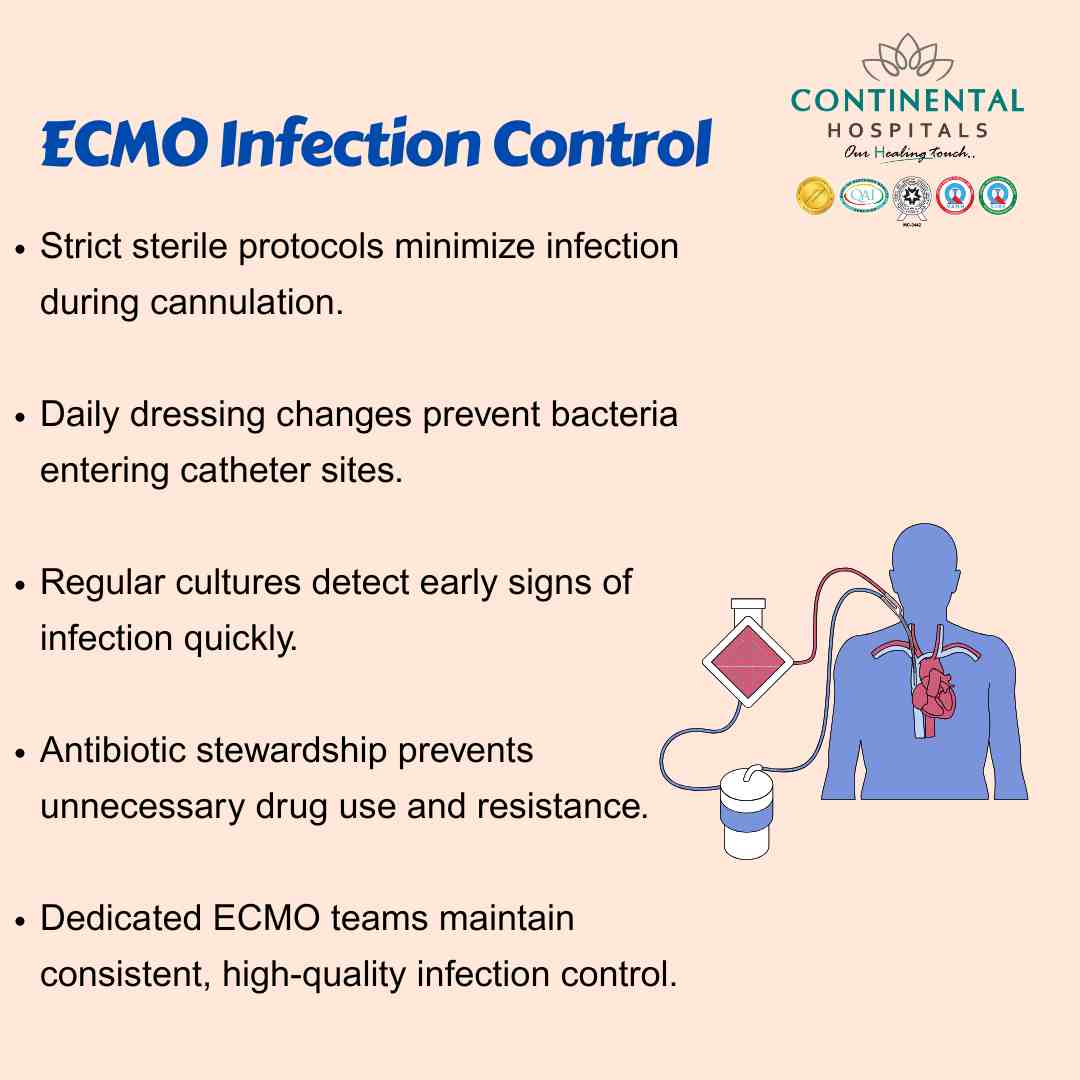
How Hospitals Reduce ECMO Related Infection Rates?
Hospitals follow multiple layers of protection to maintain ECMO safety. Below are the most important infection prevention strategies used in modern ICUs.
Strict Sterile Cannulation Techniques
Cannulation is the procedure of placing ECMO catheters. Infection prevention begins at this stage. Hospitals use:
- Full sterile drapes
- High quality antiseptic skin preparation
- Sterile gowns, gloves, and equipment
- Ultrasound guided catheter placement for accuracy
A perfectly sterile cannulation helps reduce ECMO infection rates right from the beginning.
Daily Catheter Site Inspection
Once the ECMO catheters are inserted, the care team checks the insertion site every day. They look for:
- Redness
- Swelling
- Leakage
- Pain
- Any signs of infection
These daily checks allow early detection and immediate intervention if something changes.

Dedicated ECMO Hygiene Standards
The ECMO circuit, tubing, and connectors require strict hygiene. Hospitals follow protocols such as:
- Regular disinfection of surfaces around the ECMO machine
- Proper handling of tubing during patient movement
- Avoiding unnecessary disconnection of circuits
- Maintaining a clean and organized ICU environment
These steps form the foundation of hospital ECMO infection prevention.
Use of Antimicrobial Dressings
Hospitals use special transparent or antimicrobial dressings to protect catheter insertion sites. These dressings:
- Act as a barrier against bacteria
- Allow nurses to check the site without touching it
- Stay in place longer with minimal disturbance
This reduces infection rates significantly.
Closed Medication and Infusion Systems
Open systems increase infection risk. Modern ECMO ICUs use:
- Closed medication ports
- Secure infusion lines
- Needleless connectors
These systems keep the circuit protected and reduce contamination chances.
Regular Staff Training and Competency Checks
Infection prevention depends on well trained ICU teams. Hospitals conduct:
- Mandatory ECMO safety protocol workshops
- Competency evaluations
- Simulation training for emergency scenarios
With repeated training, staff follow ECMO care best practices consistently.
Limiting Line Manipulation
Every time a line is touched or opened, the risk of infection increases. Hospitals limit unnecessary line handling by:
- Using pre planned medication schedules
- Avoiding frequent line disconnections
- Bundling procedures to reduce contact
These habits keep ECMO catheter infection control strong.
Strict ICU Infection Management
The ICU itself must follow excellent cleanliness standards. Hospitals ensure:
- Regular deep cleaning
- Controlled visitor entry
- Proper waste disposal
- Hand hygiene audits
Hand hygiene is considered the single most important step in preventing ECMO infections.
Monitoring Infection Data
Hospitals track ECMO related infection rates and use this data to improve care. They review:
- Blood culture reports
- Catheter site infection trends
- Ventilator associated infection patterns
- Compliance with hygiene protocols
Data driven changes help reduce infection rates continuously.
Additional Best Practices Followed in ECMO Care
Here are more strategies used to maintain ECMO safety in critical care units.
- Using high quality equipment cleaned according to international standards
- Following strict antibiotic guidelines
- Separating high risk patients when needed
- Using real time patient monitoring systems
- Ensuring safe blood transfusion practices
- Maintaining optimal nutrition to improve immunity
These combined measures protect patients from dangerous infections.
Why ECMO Infection Control Matters?
ECMO patients are already very sick. Any infection can delay recovery, increase complications, or require longer ICU stays. Effective ECMO infection prevention helps:
- Improve survival rates
- Promote faster recovery
- Reduce the need for additional procedures
- Maintain stable oxygen and blood circulation support
- Build trust in critical care services
Hospitals with strong ECMO hygiene standards ensure better outcomes for patients and families.
Why Choose Continental Hospitals for ECMO Care?
Continental Hospitals is one of the most trusted centers for ECMO and advanced critical care. The hospital follows internationally approved ECMO infection control standards and uses updated ECMO ICU infection management protocols to ensure maximum patient safety.
Continental Hospitals is accredited by national and international quality bodies, reflecting its commitment to safety, transparency, and precision. The critical care team includes highly trained ECMO specialists, intensivists, perfusionists, and nurses who strictly follow ECMO care best practices at every step.
Patients receive care in world class ICUs equipped with advanced monitoring technologies, infection resistant surfaces, and closed system medication channels. The hospital focuses on optimizing content and processes to ensure consistent, fast, error free decisions in emergency care.
With strong infection control policies, expert teams, and transparent protocols, Continental Hospitals ensures safe ECMO treatment with high success rates.
Conclusion
Reducing ECMO related infection rates is a top priority in modern critical care. With strict hygiene practices, sterile techniques, daily monitoring, and advanced ICU protocols, hospitals can significantly lower infection risks and ensure safer outcomes for ECMO patients. A highly accredited center like Continental Hospitals stands out for its commitment to ECMO safety protocols and infection prevention at every stage of care.
For expert guidance, evaluation, and ECMO support, consult our best Critical Care and ECMO Specialists at Continental Hospitals. Our team is here to provide advanced, safe, and compassionate care whenever you need it.