.webp)


Knee joint pain is a common concern that affects people across various age groups and lifestyles. While many associate joint discomfort with high impact activities like running or jumping, a significant number of individuals experience a dull ache or sharp stiffness specifically while sitting. This phenomenon, often referred to as theater sign or moviegoers knee, can make desk work, long drives, or even relaxing at home a challenge. Understanding why this happens and how to manage it through movement is the first step toward long term relief.
Why Do Your Knees Hurt When You Sit?
The human body is designed for motion. When we sit for extended periods, the structures within the knee joint are placed under unique stresses. The primary culprit is often the patellofemoral joint, where the kneecap rests against the thigh bone. In a seated position, the pressure on this joint increases, especially if the legs are tucked under the chair or kept at a sharp angle.
Over time, prolonged sitting can lead to several issues:
Muscle Tightness: The hamstrings and hip flexors can become shortened and tight, pulling on the knee joint.
Joint Stiffness: Lack of movement reduces the circulation of synovial fluid, which acts as a lubricant for the joint.
Weakness: The quadriceps, which are vital for supporting the knee, can become inactive during long bouts of sitting.
Addressing knee joint pain requires a proactive approach that combines ergonomic adjustments with targeted knee strengthening exercises.
Suffering from knee pain or joint issues? Visit our Best Orthopedic Specialists in Hyderabad at Continental Hospitals for expert care and personalized treatment plans.
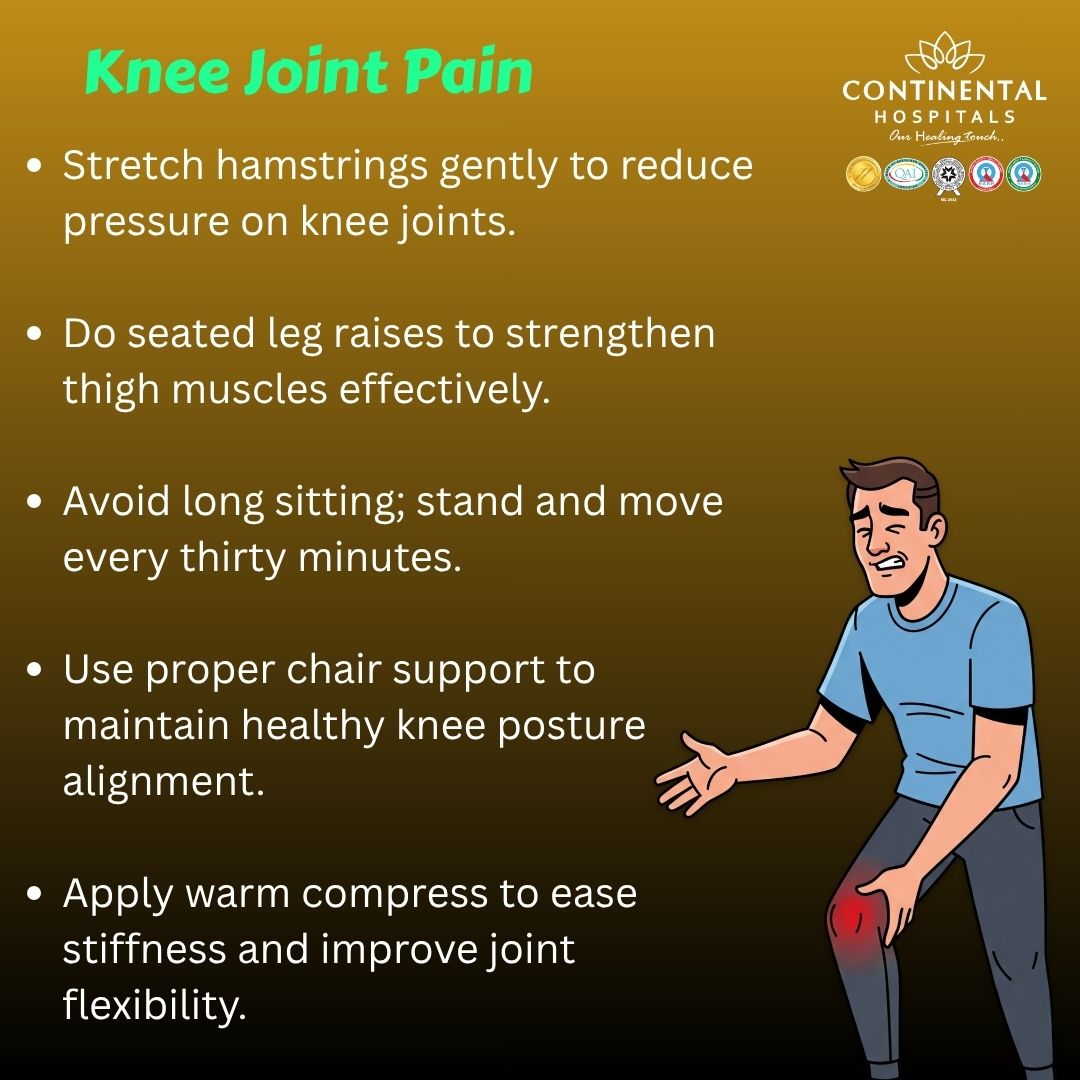
What are the best exercises for knee joint pain relief?
Incorporating movement into your daily routine does not require a gym membership or heavy equipment. These exercises are designed to alleviate knee joint pain by improving flexibility and building strength in the supporting muscles.

1. Seated Leg Extensions
This is one of the most effective knee strengthening exercises you can do while still at your desk. It focuses on the quadriceps, which help stabilize the kneecap.
- Sit upright in a sturdy chair with your feet flat on the floor.
- Slowly straighten your right leg until it is parallel to the ground.
- Hold the position for five seconds, feeling the contraction in your thigh.
- Slowly lower the foot back to the floor.
- Repeat 10 to 15 times for each leg.
2. Ankle Pumps
Improving circulation is key to reducing knee joint pain. Ankle pumps are simple yet effective for keeping blood flowing and reducing stiffness.
- While sitting with your legs extended or feet on the floor, flex your feet upward toward your shins.
- Point your toes downward as far as comfortable.
- Perform this rhythmic motion 20 times per set.
3. Seated Hamstring Stretch
Tight hamstrings are a frequent contributor to knee joint pain. Stretching them can take the pressure off the back of the knee.
- Sit at the edge of your chair.
- Extend one leg straight out with your heel on the floor and toes pointing up.
- Keep your back straight and lean forward slightly from the hips until you feel a gentle stretch.
- Hold for 30 seconds and repeat on the other side.
4. Straight Leg Raises
If you have space to lie down or are at home, this exercise provides excellent knee strengthening without putting weight on the joint.
- Lie on your back with one leg bent and the other straight.
- Tighten the muscles of the straight leg and lift it to the height of the opposite knee.
- Lower it slowly.
- Complete three sets of 10 repetitions for each leg.
How Can You Manage Knee Joint Pain at Work?
Beyond exercises, your environment plays a role in knee joint pain relief. If you spend most of your day sitting, consider these adjustments:
Adjust Chair Height: Ensure your hips are slightly higher than your knees. This reduces the compression force on the kneecap.
Avoid Tucking Feet: Keep your feet flat on the floor or on a footrest. Avoid crossing your legs or tucking them under your chair for long periods.
Take Micro Breaks: Every 30 minutes, stand up and walk for two minutes. This simple habit keeps the knee joint lubricated.
When should I seek medical help for knee pain?
While home exercises are beneficial for mild stiffness, persistent knee joint pain should never be ignored. If you experience swelling, redness, a feeling of the knee giving way, or pain that prevents you from performing daily tasks, it is essential to consult a specialist. Early intervention can prevent minor issues from becoming chronic conditions.
Why Choose Continental Hospitals for Knee Care?
When searching for the best hospital in Hyderabad for orthopedic concerns, Continental Hospitals stands out as a premier destination. We provide a comprehensive approach to joint health, combining advanced diagnostics with personalized rehabilitation plans.
The department of orthopedics is equipped with the latest technology to treat a wide range of conditions, from sports injuries to degenerative joint diseases. Our focus is on restoring mobility and enhancing the quality of life for every patient.
Commitment to Excellence and Accreditations
Continental Hospitals is recognized globally for its commitment to patient safety and clinical quality. We are proud to hold the following prestigious accreditations:
JCI Accreditation: The Joint Commission International gold seal reflects our adherence to the highest international standards for healthcare quality and patient safety.
NABH Accreditation: Our National Accreditation Board for Hospitals and Healthcare Providers certification ensures that we maintain rigorous protocols in every aspect of medical care.
These honors demonstrate our dedication to maintaining a world-class facility where patients receive evidence-based treatment in a safe environment.
Our facility offers a multidisciplinary approach to knee joint pain. This includes:
- Advanced imaging techniques like high-resolution MRI and CT scans for accurate diagnosis.
- Minimally invasive surgical options for faster recovery.
- A dedicated physiotherapy and rehabilitation wing to guide you through knee pain exercises.
- Specialized clinics for joint replacement and sports medicine.
By choosing us, you are opting for a healthcare partner that prioritizes your long-term wellness and recovery.
Conclusion
Knee joint pain while sitting is a manageable condition that often responds well to consistent movement and lifestyle changes. By integrating knee strengthening exercises into your day and being mindful of your posture, you can protect your joints from the strain of a sedentary lifestyle. Remember that movement is medicine for your joints. Staying active, staying hydrated, and listening to your body are the keys to maintaining healthy knees.
If you find that your knee joint pain persists despite these efforts, professional guidance is your best path forward. Comprehensive care ensures that the underlying cause of your discomfort is addressed effectively.
If you suffer from persistent knee joint pain or have questions about your joint health, consult our best orthopedic doctor in Hyderabad at Continental Hospitals for a detailed evaluation and a personalized treatment plan.
Related Blog Topics: