• Share this:
post-title

Why Hormone Therapy Sometimes Fails in Breast Cancer

Written by - Editorial Team
Medically Reviewed by - Dr Banda Ravi Teja

Hormone therapy is a powerful weapon against specific types of breast cancer, especially those that need hormones like estrogen to grow? However, there are times when this treatment stops working, leading to what medical professionals call breast cancer hormone therapy failure. When hormone therapy breast cancer treatments face obstacles, patients often wonder why a once-effective plan is no longer keeping the cancer cells in check. Understanding the mechanics behind endocrine therapy resistance and breast cancer treatment resistance helps patients and oncologists stay ahead of the disease by adjusting treatment protocols effectively.

At Continental Hospitals, recognized widely as the best hospital in Hyderabad, we believe that education empowers patients during their healing journey. Breast cancer cells can be highly adaptable, and over time, they find clever ways to bypass the medications designed to block them. By diving into the scientific reasons behind why hormone therapy stops working, we can look at how advanced diagnostics and personalized treatment adjustments help overcome these challenges. Let us explore the key questions surrounding this topic to understand how breast cancer treatment resistance develops and what steps can be taken next.

What is the role of hormone therapy in breast cancer treatment?

  • Targeting Hormone Receptors: A large percentage of breast cancer cases are estrogen receptor-positive (ER-positive), meaning the cancer cells use estrogen to multiply?
  • Blocking the Fuel Supply: Hormone therapy breast cancer drugs work by either lowering the amount of estrogen in the body or by blocking estrogen from attaching to the cancer cells.
  • Preventing Recurrence: Doctors prescribe this therapy after surgery, radiation, or chemotherapy to destroy any remaining microscopic cancer cells and minimize the risk of the cancer returning.
  • Long-Term Protection: This treatment is typically taken as a daily medication for five to ten years, providing an ongoing shield against cancer activity.

Experiencing recurrence symptoms or treatment concerns? Visit the Medical Oncology Department at Continental Hospitals, Hyderabad, for expert care.

Why Does Endocrine Therapy Resistance Occur?

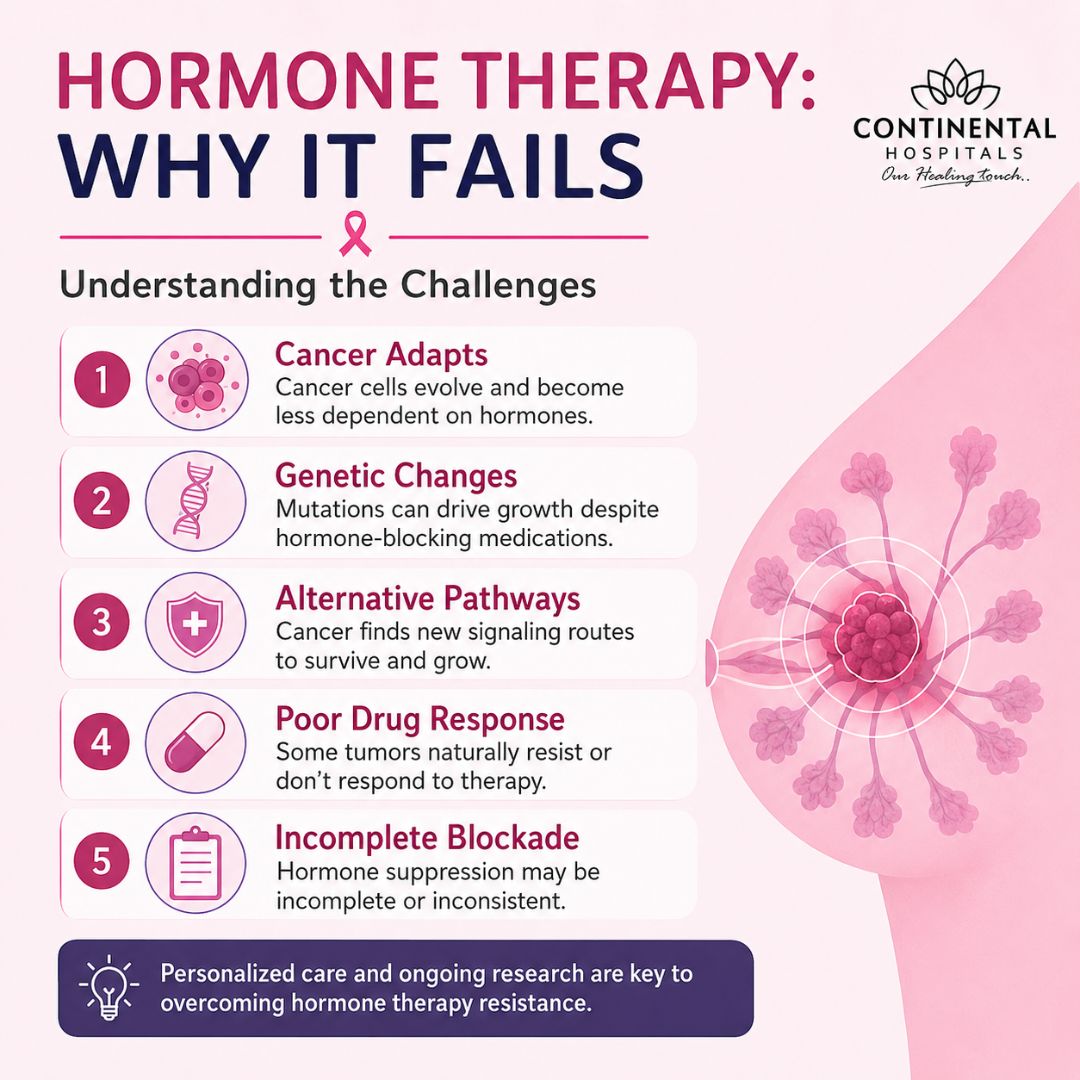
  • Genetic Mutations in Cancer Cells: Over time, breast cancer cells can develop genetic mutations, such as variations in the ESR1 gene? These changes allow the receptors to stay turned on and keep growing even when estrogen is completely blocked.
  • Alternative Growth Pathways: If the main door for estrogen is locked by medication, the cancer cells can adapt by opening alternative chemical pathways inside the cell, completely bypassing the need for estrogen to survive.
  • Tumor Heterogeneity: A single breast cancer tumor contains billions of cells that are not all identical. While hormone therapy kills off the estrogen-dependent cells, a small group of cells that do not care about estrogen might survive, multiply, and cause a relapse.
  • Loss of Estrogen Receptors: In some cases of breast cancer hormone therapy failure, the cancer cells stop displaying estrogen receptors altogether, making the current hormone-blocking drugs ineffective.
What Are the Main Signs That Breast Cancer Hormone Therapy Failure Has Occurred?

  • New Physical Symptoms: The appearance of unexplained lumps, persistent bone pain, an ongoing cough, or sudden weight loss can indicate that the cancer is active again.
  • Changes in Blood Biomarkers: Regular follow-up blood tests may show a rise in specific tumor markers, signaling to your oncologist that the treatment might be losing its grip.
  • Abnormal Imaging Results: Routine surveillance scans, such as mammograms, ultrasounds, CT scans, or PET scans, might reveal new tumor growth or show that an existing tumor is expanding.
  • Local or Distant Recurrence: Breast cancer treatment resistance can manifest either as a tumor returning in the same breast or spreading to distant organs like the bones, liver, or lungs.

How Do Doctors Manage a Situation Where Hormone Therapy Stops Working?

  • Switching the Type of Medication: If one specific hormone drug fails, oncologists often switch to a different class of medication, such as moving from an aromatase inhibitor to a selective estrogen receptor downgrader.
  • Combining Treatments with Targeted Therapies: Modern medicine uses advanced targeted drugs, like CDK4/6 inhibitors or mTOR inhibitors, alongside hormone therapy to block the backup pathways that cancer cells use to escape.
  • Transitioning to Chemotherapy: When breast cancer displays widespread resistance to multiple hormone-based options, changing the strategy to systemic chemotherapy helps directly destroy fast-dividing cells.
  • Utilizing Next-Generation Sequencing: Doctors can run advanced genetic tests on the tumor tissue or blood to pinpoint the exact mutation causing the resistance, allowing for highly specific medication choices.

Why Choose Continental Hospitals for Breast Cancer Care?

Choosing the right partner for your cancer care makes all the difference when tackling complex issues like breast cancer treatment resistance. Continental Hospitals stands out as a premier institution for comprehensive oncology care in Hyderabad due to our unwavering commitment to global standards.

  • World-Class Accreditations: Continental Hospitals holds the prestigious Joint Commission International (JCI) accreditation, earning the global "Gold Seal" of approval for patient safety and clinical quality. We are also fully accredited by the National Accreditation Board for Hospitals & Healthcare Providers (NABH), ensuring that our clinical protocols, infection control, and patient care systems meet the highest national benchmarks.
  • Multidisciplinary Tumor Board: Our breast cancer specialists do not work in isolation. Complex cases of endocrine therapy resistance are reviewed by a collaborative panel of surgical, medical, and radiation oncologists to craft a unified, precise treatment strategy.
  • Advanced Molecular Diagnostics: We utilize cutting-edge genetic profiling and liquid biopsies to discover exactly why hormone therapy stops working in an individual patient, eliminating guesswork.
  • State-of-the-Art Infrastructure: From advanced radiation technologies to dedicated, safe chemotherapy infusion suites, our facility is engineered to provide a healing environment built on international safety standards.

Conclusion

Hormone therapy remains a cornerstone of defense against ER-positive breast cancer, but the structural adaptability of cancer cells means that resistance can sometimes develop. Experiencing breast cancer hormone therapy failure is a challenging hurdle, but it does not mean that options have run out. By understanding the underlying cellular changes and leveraging combination therapies, advanced diagnostics, and alternative medication groups, modern oncology can effectively counter these resistance mechanisms. Early detection of treatment changes, paired with an expert clinical team, ensures that your therapeutic path can be adjusted seamlessly to keep you on the road to recovery.

If you suffer from symptoms of recurrence or have questions about your current treatment plan, consult our best medical oncologist in Hyderabad at Continental Hospitals.

Related Blog Topics:

  1. Alcohol and Breast Cancer: Key Facts for Women
  2. Different Types of Breast Cancer

Second Opinion

Need an Appointment?

Frequently Asked Questions

Hormone therapy may stop working when breast cancer cells develop resistance to treatment over time. These cancer cells can adapt and find alternative pathways to grow even when estrogen or progesterone is blocked. Genetic mutations in tumor cells can alter how they respond to therapy, reducing treatment effectiveness. Some cancers become less dependent on hormones and begin using other growth signals. Changes in the tumor microenvironment may also support cancer survival despite treatment. In certain cases, incomplete suppression of hormone production can contribute to resistance. Long-term exposure to hormone therapy may select for resistant cancer cell populations. Researchers continue to study the biological mechanisms behind resistance. Understanding why therapy fails helps doctors choose alternative treatment options. Regular monitoring can identify resistance early and improve disease management. Personalized treatment strategies are increasingly important for patients facing hormone therapy resistance.
Hormone therapy resistance refers to the ability of hormone receptor-positive breast cancer cells to survive and grow despite treatments designed to block hormonal stimulation. Resistance can be classified as primary, where treatment never works effectively, or acquired, where cancer initially responds but later progresses. Biological changes inside tumor cells often drive resistance. Mutations in estrogen receptor genes can alter treatment sensitivity. Cancer cells may activate alternative signaling pathways that bypass hormonal controls. Resistance can develop gradually as tumors evolve under treatment pressure. Identifying resistance early is essential for selecting effective therapies. Advanced diagnostic tests may help detect molecular changes linked to treatment failure. Researchers are developing targeted therapies to overcome resistance mechanisms. Combining treatments is another strategy to improve outcomes. Understanding hormone therapy resistance allows physicians to personalize treatment plans and optimize patient care.
Yes, genetic mutations are among the leading causes of hormone therapy failure in breast cancer. Mutations in genes such as ESR1 can change how estrogen receptors function, making certain therapies less effective. These alterations allow cancer cells to continue growing even when hormone signals are blocked. Other genetic changes may activate pathways that promote cell survival and proliferation. As tumors evolve, they can accumulate additional mutations that increase treatment resistance. Modern genomic testing can identify these molecular changes and guide treatment decisions. Detecting mutations helps oncologists choose targeted therapies when standard hormone treatments are no longer effective. Research continues to uncover new resistance-related genetic alterations. Personalized medicine approaches are becoming increasingly important in managing resistant breast cancer. Understanding the genetic basis of resistance helps improve long-term treatment strategies and patient outcomes.
Doctors determine whether hormone therapy is losing effectiveness through regular monitoring and clinical evaluation. Signs may include tumor growth, disease progression on imaging scans, or the appearance of new cancer lesions. Blood tests and tumor marker assessments can provide additional information about treatment response. Patients may also experience worsening symptoms that indicate disease activity. Advanced imaging techniques help identify changes that suggest resistance. In some cases, a biopsy may be performed to analyze new tumor characteristics and detect genetic mutations. Molecular testing can reveal biological changes responsible for treatment failure. Early identification of resistance allows physicians to modify treatment plans promptly. Alternative hormone therapies, targeted drugs, or chemotherapy may be recommended. Ongoing follow-up appointments are essential for evaluating treatment effectiveness and maintaining optimal cancer management.
Yes, some breast cancers have a higher likelihood of developing resistance to hormone therapy than others. Tumors with aggressive biological features may adapt more quickly to treatment pressure. Certain genetic mutations and molecular alterations increase the risk of resistance. Advanced-stage breast cancers are often more complex and may contain diverse cancer cell populations capable of surviving therapy. Tumors with high proliferation rates may also be more prone to treatment failure. Researchers have identified biomarkers that can help predict resistance risk. Understanding the molecular characteristics of a tumor allows physicians to tailor treatment strategies more effectively. Regular monitoring is particularly important for higher-risk patients. Combining hormone therapy with targeted medications may reduce the chance of resistance. Ongoing research aims to identify which patients will benefit most from specific treatment approaches.
When hormone therapy fails, several alternative treatment options may be available depending on the patient's condition and tumor characteristics. Doctors may switch to a different hormone therapy medication if some hormone sensitivity remains. Targeted therapies such as CDK4/6 inhibitors are commonly used to overcome resistance. PI3K inhibitors and other precision medicines may be recommended for patients with specific genetic mutations. Chemotherapy may be considered when the disease becomes more aggressive or widespread. Clinical trials can provide access to emerging therapies under investigation. Treatment decisions are guided by imaging studies, molecular testing, and overall health status. Personalized treatment plans help maximize effectiveness while minimizing side effects. Advances in cancer research continue to expand the options available for resistant breast cancer. Close collaboration between patients and oncology teams is essential for selecting the most appropriate treatment strategy.
Completely preventing hormone therapy resistance is not always possible, but several strategies may reduce the risk or delay its development. Adhering closely to prescribed treatment schedules is important for maintaining therapeutic effectiveness. Regular follow-up appointments help detect early signs of resistance. Combining hormone therapy with targeted medications has shown promise in improving outcomes. Lifestyle factors such as maintaining a healthy weight, exercising regularly, and avoiding tobacco may support overall health during treatment. Advances in genomic testing allow doctors to identify patients at higher risk for resistance. Personalized treatment approaches can be designed based on individual tumor biology. Ongoing research is exploring new methods to prevent cancer cells from adapting to therapy. Early intervention when resistance begins to emerge may improve long-term disease control. Continuous innovation in breast cancer treatment offers hope for more durable responses.
Personalized medicine plays a critical role in managing breast cancer when hormone therapy becomes ineffective. By analyzing the genetic and molecular characteristics of a patient's tumor, doctors can identify specific drivers of treatment resistance. This information helps guide the selection of targeted therapies that address the underlying biology of the cancer. Personalized approaches improve the likelihood of choosing effective treatments while avoiding unnecessary side effects. Molecular profiling can reveal mutations that qualify patients for precision medicines or clinical trials. Treatment plans can be adjusted as tumors evolve over time. Personalized medicine also supports more accurate risk assessment and monitoring strategies. Advances in genomic technologies continue to enhance treatment decision-making. Many experts consider precision oncology a key component of modern breast cancer care. As research progresses, personalized therapies are expected to improve outcomes for patients facing hormone therapy resistance.
Disclaimer: The information provided in this blog is intended for general knowledge and informational purposes only, and does not constitute medical advice. Always consult with a qualified healthcare professional for any medical concerns or before making any decisions about your health.

Get in Touch With Us

Whether you are from India or abroad, we are here to help you with your medical queries. Please fill out the form below and our team will connect with you shortly.

  • ✔ Quick response from our medical experts
  • ✔ Secure data handling & privacy
  • ✔ Easy upload for reports & documents
0 / 100
Checkboxes Section


Chat with our medical experts on WhatsApp for quick assistance and hassle-free appointment booking

Recent Posts
Language Based Image
0 / 100