.webp)

What is BMI, and how is it relevant for health professionals & practitioners? BMI, which stands for Body Mass Index, is a simple measurement that helps determine if someone's weight is within what is ordinarily considered normal for their height. BMI is calculated based on a person's height and weight, and it is frequently used as the initial measure to determine possible health conditions in connection with body weight.
If people understand what BMI is and how it works, they can learn more about their body weight and health. Still, it is necessary to understand that BMI is only relative for the determination of health. It does not provide an accurate estimation of body fat and how it distributes in the human body.
What does BMI stand for?
BMI refers to Body Mass Index. It is a quantified measurement determined by the person’s weight and height.
To calculate BMI, the following formula is used:
BMI = Weight (kg) / Height (m) x Height (m)
For instance, a person with 70 kg weight and 1.70 m height will have a BMI equal to weight divided by height squared.
It is possible to use a BMI calculator for an easier and faster BMI calculation.
Visit the Internal Medicine Department at Continental Hospitals, Hyderabad, for expert evaluation, preventive care, and personalised treatment.
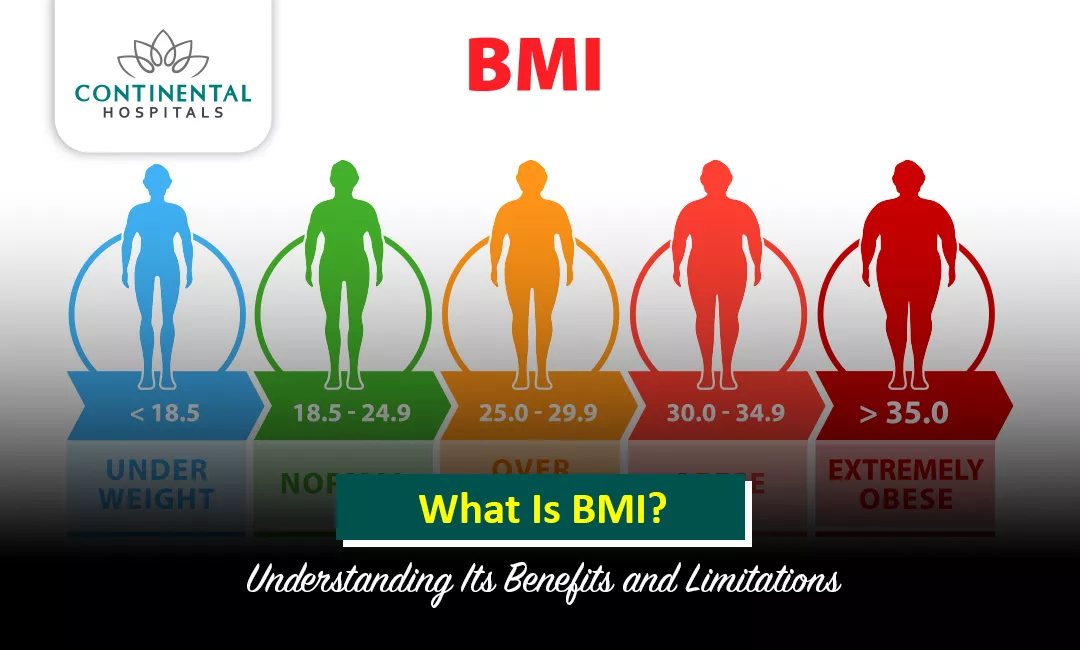
What are the categories of BMI?
What does the BMI signify? There are general BMI classifications for adults:

• Below 18.5: Underweight
• 18.5 ‒ 24.9: Healthy weight
• 25 ‒ 29.9: Overweight
• 30 and above: Obesity
Because it is a general method of screening, it shouldn’t be delved into too much, as the state of health of the individuals can vary.
At the same time, BMI measurements are interpreted differently for children, adolescents, pregnant women, athletes, and others. For instance, for children, BMI is calculated based on their age and gender.

What Are the Advantages of BMI?
Can BMI have its benefits despite its limitations? The answer is yes. BMI can allow tracking one's weight and suggest if it is outside of the recommended range.
A few of the most significant benefits of BMI include:
- Easy computation: BMI can be calculated using height and weight easily.
- Helpful for screening: Doctors can use BMI as an indication of the possible health problems associated with a person's weight.
- Monitoring weight changes: Observing BMI over time can help notice obvious changes in weight.
- Providing discussions related to health: BMI allows starting conversations about nutrition, exercising, and healthy lifestyle choices.
- Important for public health purposes: BMI is greatly used in scientific research and in assessing public health in general.
BMI has some limitations, which prevent it from being a fully reliable indicator of health. It should be understood that this indicator does not take into account the following aspects of body composition and health:
- the amount of muscle in the body
- the amount of body fat a person has
- fat’s distribution in the body
- bone density
- muscle strength
- metabolic health
- dietary habits
- fitness level.
To illustrate, people with a great amount of muscle can have a high BMI, although, in reality, they can have low levels of body fat. In the same way, people with the same levels of BMI may have different levels of body fat.
Is having a healthy BMI sufficient to indicate that one is in good health?
Can someone be in great shape with a BMI within the healthy range? Yes. Just because your BMI is classified as healthy doesn’t mean you have optimal health.
There are various other factors that may play a role in determining your health assessment:
- Waist size
- Blood pressure
- Blood sugar levels
- Cholesterol levels
- Physical activity
- Diet
- Quality of sleep
- Genetic factors
- Pre-existing health conditions
This is why it is important to consider BMI when assessing your health.
How can you use the BMI calculator correctly?
How can BMI diagnose your health condition? You simply input weight and height in the BMI calculator to see which BMI category you fall into.
However, what should a person do about the result?
Rather than worrying or being happy about the result, talk to a doctor if you have any concerns about your health condition.
The importance of understanding BMI (Body Mass Index)
Why is it crucial to grasp BMI instead of just knowing one’s number?
Understanding BMI enables us to see both its advantages and downfalls.
The outcome of BMI may prompt you to take care of your health, but it should not serve as the only indicator.
Some positive actions include:
- Having a healthy diet
- Being physically active
- Getting enough sleep
- Managing stress
- Going to check the health periodically
- Keeping important indicators of wellness under control
- Consulting the doctor whenever necessary
What are the reasons for selecting Continental Hospitals for health and wellness services?
Why is it essential to seek professional help while determining one’s weight and health? Good weight management has several components like nutrition, exercise, metabolic health, hormones, and preexisting conditions. With the help of a thorough medical assessment, various elements of one’s health can be identified that are not indicated by BMI.
Continental Hospitals in Hyderabad offer complete health services supported by a skilled medical team, state-of-the-art diagnostic facilities, and an excellent infrastructure. The hospital received accreditations of JCI and NABH, which indicate the firm's compliance with the standards set within the system of healthcare.
What is vital to remember when measuring BMI?
- BMI is a body mass index.
- In BMI calculation, height and weight are taken into consideration.
- BMI calculators facilitate fast calculations of BMI.
- BMI categories form a basis for health assessments of adults.
- Normal BMI cannot guarantee perfect health.
- BMI does not directly measure fat or muscle.
- The limitations of BMI must be accounted for when making interpretations.
- BMI should be used with other health-related measures.
- Children’s and adolescents’ BMI should be calculated according to their age and sex.
- The advice of a healthcare professional is useful in better understanding health indicators.
Conclusion
So, what is BMI, and how should you use it? BMI is a useful screening measurement that can provide general information about the relationship between a person's height and weight. However, it has important limitations and should not be considered a complete assessment of health.
Understanding BMI, BMI Meaning, Body Mass Index, BMI Categories, BMI Range, BMI Benefits, and BMI Limitations can help you make more informed decisions about your health. If you are concerned about your weight, BMI result, blood sugar, blood pressure, or other health factors, a healthcare professional can help you understand the bigger picture.
If you are concerned about your BMI, weight management, or related health conditions, consult our best internal medicine specialist in Hyderabad at Continental Hospitals, Hyderabad, for a comprehensive health assessment and personalized medical guidance.
Related Blogs: