.webp)


You have likely seen it in your grandmother’s kitchen. That jar of golden liquid that smells like home and comfort. For centuries, ghee has been the superstar of Indian cooking. It is poured over dal, brushed on rotis, and used to make delicious sweets. But in recent years, a lot of confusion has appeared. People started asking if this traditional staple is actually good for us or if it clogs our arteries.
When it comes to ghee health, opinions are often divided. One group calls it a superfood, while another fears the fat content. If you are trying to balance a modern lifestyle with traditional eating habits, you need the facts. Let us break down the truth about ghee and your heart in simple terms.
The Golden Liquid: Understanding Ghee Nutrition
Before we decide if it is good or bad, we must understand what it is. Ghee is essentially clarified butter. This means the milk solids and water have been removed, leaving behind pure fat. Because of this process, ghee butter benefits include being lactose-free. People who cannot digest milk often find they can eat ghee without any stomach trouble.
The profile of ghee nutrition is quite impressive. It is not just empty calories. It contains healthy fats that your body needs for energy. It is rich in vitamins A, E, and K. These are fat-soluble vitamins, which means they need fat to be absorbed by your body. So, when you add a spoonful of ghee to your spinach or carrots, you are actually helping your body absorb more nutrients from the vegetables.
Heart concerns, high cholesterol, or diet doubts? Visit our General Physician Department at Continental Hospitals for expert guidance.
Is Ghee Fat Bad for Your Heart?
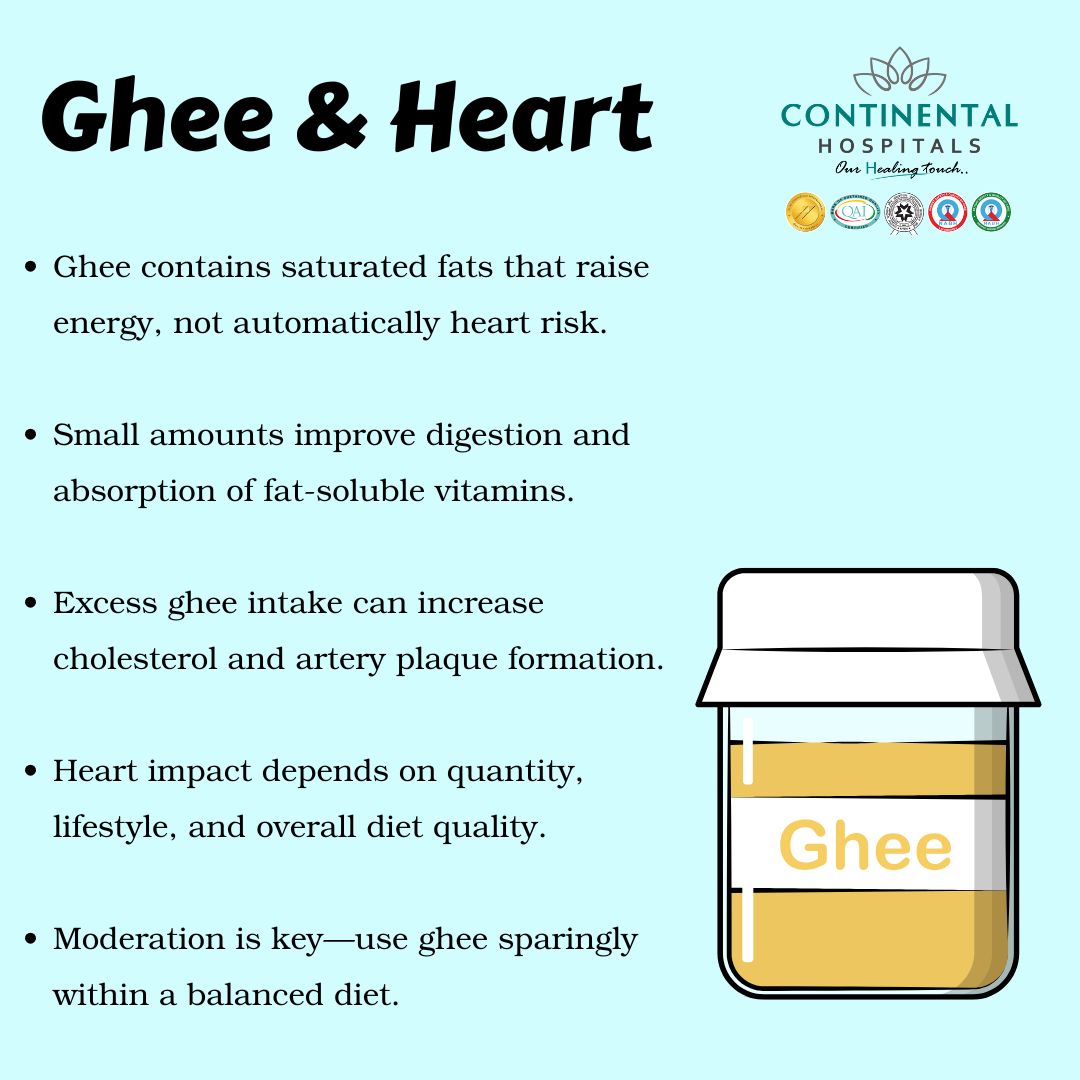
This is the biggest question. For a long time, we were told that all saturated fats are bad. Ghee fat is primarily saturated fat, which led many heart specialists to advise against it. However, science has evolved. We now know that not all fats act the same way in the body.
The advantage of eating ghee lies in moderation. Ghee contains Omega-3 fatty acids, which are known to reduce inflammation in the body. Inflammation is a key driver of heart disease. Furthermore, ghee contains Conjugated Linoleic Acid (CLA). Studies suggest that CLA can actually help in reducing body fat and preventing plaque formation in arteries.
The problem arises only when you consume it in excess or if you lead a very sedentary lifestyle. If you sit at a desk all day and eat oily food, the extra calories will store up. But if you are active and use ghee in limited quantities, about one or two teaspoons a day, it can actually support your heart health rather than harm it.

Cow Ghee Benefits vs. Buffalo Ghee
Not all ghee is the same. The source of the milk matters.
Cow Ghee Benefits: This is the most popular type. It is yellow in color and lighter on the stomach. It is generally considered better for heart patients and children because it has lower fat content compared to buffalo ghee. In Ayurveda, cow ghee is revered for boosting memory and intelligence.
Benefits of Buffalo Ghee: This ghee is white and much thicker. It has more calories and fat. While it is great for people looking to gain weight or bodybuilders who need high energy, it might not be the best choice if you are strictly watching your cholesterol levels.
10 Reasons to Include Ghee in Your Diet
If you are still wondering about the advantage of desi ghee, here is a simple checklist of why it deserves a place in your kitchen:
High Smoke Point: Unlike olive oil or butter, ghee does not burn easily. This prevents the release of harmful free radicals during cooking.
Gut Health: Desi ghee benefits your digestion by stimulating the secretion of stomach acids to break down food.
Lubrication: It keeps your joints flexible and lubricated, reducing stiffness.
Immunity Booster: The antioxidants in ghee help strengthen your immune system.
Healthy Skin: The fats in ghee hydrate your skin from within.
Hormonal Balance: Fat is essential for hormone production, and ghee provides the good kind.
Brain Function: The saturated fats in ghee support the myelin sheath that protects nerve cells.
Weight Management: The unique fatty acids in ghee help mobilize fat cells to be burnt for energy.
Lactose-Free: Safe for those with dairy sensitivities.
Nutrient Absorption: It acts as a carrier for vital nutrients.
Beyond Eating: Benefits of Applying Ghee on Face
Ghee health is not just about what you eat. It is also about how you look. The benefits of applying ghee on face are a well-kept beauty secret.
Deep Moisturizer: It penetrates deep into the skin to heal dryness.
Anti-Aging: Vitamin E in ghee helps fight fine lines and wrinkles.
Dark Circles: Gently massaging a drop of ghee under your eyes can brighten the area.
Chapped Lips: It is the best natural lip balm you can find.
How to Use Ghee Correctly
To get the benefits eating ghee offers, you must use it wisely.
Don't Deep Fry: While it has a high smoke point, deep frying adds too many calories. Use it for sautéing or as a topping.
Raw is Gold: Pouring a teaspoon of raw ghee over hot rice or dal is the best way to consume it. This preserves all the delicate nutrients.
Morning Ritual: Some people consume a small drop of ghee with warm water in the morning to flush out toxins.
Why Choose Continental Hospitals?
When it comes to managing heart health and diet, you need advice you can trust. You need a partner who understands the balance between tradition and modern science. Continental Hospitals is the best hospital in Hyderabad for a reason.
We are committed to providing quality healthcare that meets international standards. We are proud to hold the JCI (Joint Commission International) accreditation. This is the gold standard in global healthcare, meaning our safety and quality protocols are among the best in the world. Additionally, we are accredited by the NABH (National Accreditation Board for Hospitals & Healthcare Providers).
These accreditations are your assurance that when you walk through our doors, you are in safe hands. Our team of expert cardiologists and nutritionists work together. We do not just treat the heart attack; we help you build a lifestyle that prevents it. We use the latest technology for diagnosis and treatment, ensuring accuracy and comfort for every patient.
Conclusion
So, is ghee healthy or harmful? The answer is that it is healthy, provided you treat it with respect. It is a source of energy, vitamins, and good fats. The ghee benefits are vast, ranging from better digestion to glowing skin. It is not the ghee that is the enemy; it is the excess and the lack of activity.
If you suffer from heart related concerns, high cholesterol, or are unsure about including ghee in your diet, do not self manage your nutrition.
Consult our best general physician at Continental Hospitals for personalized heart health guidance. Early medical advice helps prevent complications and ensures long term wellbeing.
Book your appointment today at Continental Hospitals and take a confident step towards a healthier heart.
Related Blog Topics: