
Comparison between heart rate and pulse rate is a popular subject matter when discussing heart-related issues. A majority of people tend to use the terms interchangeably; however, both heart rate and pulse rate are distinct measurements of your cardiovascular system. The heart rate is the frequency of beats made by your heart per minute whereas the pulse rate is the frequency at which the blood passes through the arteries.
It is worth noting that heart rate and pulse rate should always be similar in a healthy individual. Nonetheless, there may be an inconsistency between these two measurements in some individuals who suffer from various heart diseases.
What Is Heart Rate?
What will heart rate reveal to you about your heart? Heart rate is the number of times your heart is beating or pumping the blood in a minute. This shows how hard your heart is working to provide you with oxygen and nutrients.
Heart rate is generally expressed as BPM (beats per minute). It can be measured with the help of a smartwatch, fitness band, electrocardiogram, or any other monitoring device.
Various factors that may influence your heart rate are:
- Exercise and physical activity.
- Your age and fitness level.
- Stress and anxiety.
- Fever or any other kind of sickness.
- Various medicines.
- Sleep or hormonal changes.
Visit the Best Heart Specialist Hospital in Hyderabad at Continental Hospitals, Hyderabad, for expert heart care and advanced cardiac services.
What Is Pulse Rate?
What do you understand by pulse rate? Pulse rate determines the number of times that your arteries dilate and constrict due to pumping of blood in your body by the heart. Each time your heart pumps, pressure is created in the arteries and causes your pulse.
Pulse rate is usually taken through pressing on an artery with two fingers.
Common places where pulse rate can be taken include:

1. Wrist: Your pulse rate can be taken from the radial pulse at the wrist.
2. Neck: The pulse rate can be taken from your neck by feeling the carotid pulse.
3. Elbow: Your pulse can be taken from the brachial pulse in your arm.
4. Top of foot: A qualified health practitioner may take the pulse rate on your foot.
What Is the Difference Between Heart Rate and Pulse Rate?
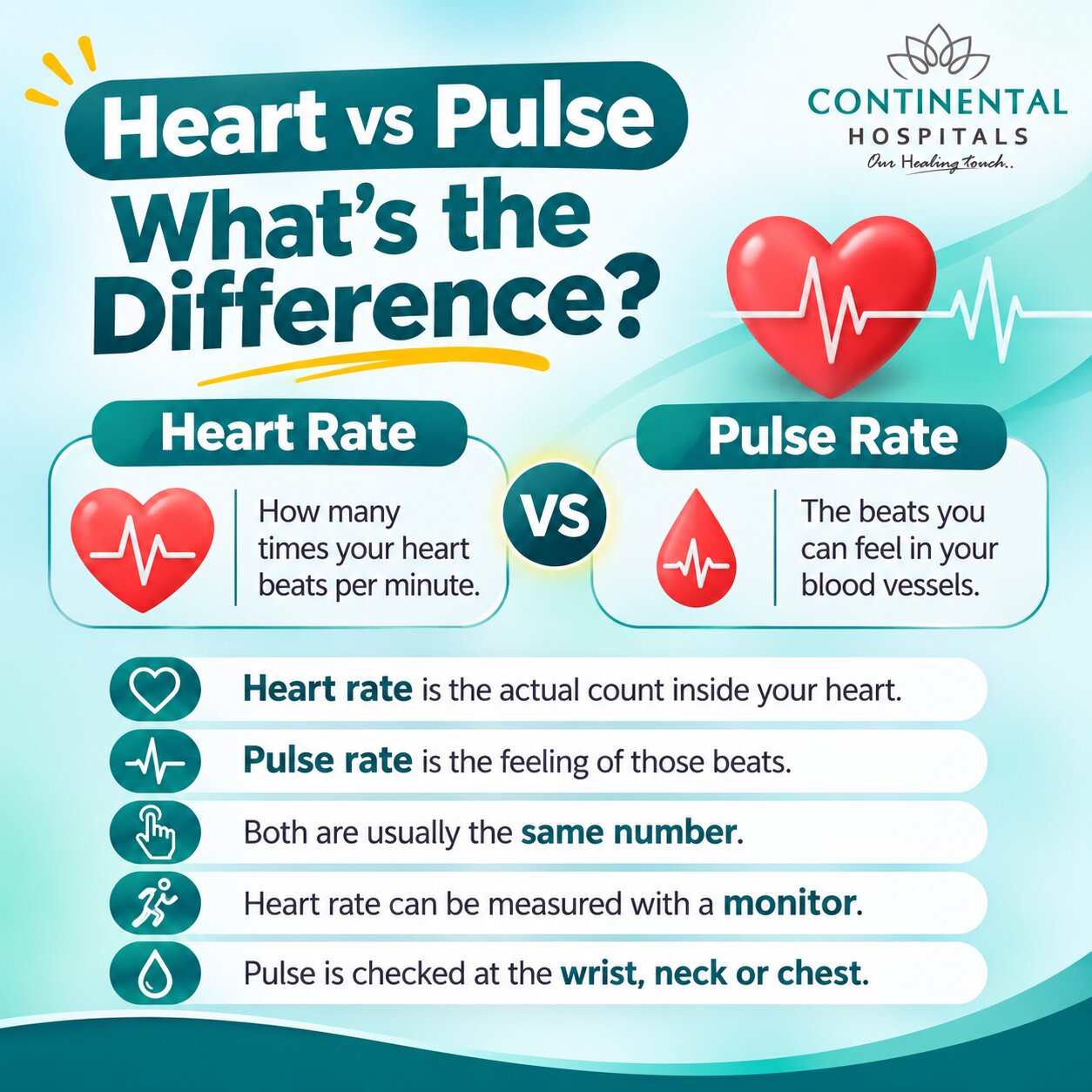
How are heart rate and pulse rate different? Both measurements provide information about cardiovascular activity, but they are measured in different ways.
| Feature | Heart Rate | Pulse Rate |
| Meaning | Number of heartbeats per minute | Number of detectable arterial pulses per minute |
| Measurement | Measures heart activity | Measures blood pressure waves in arteries |
| Method | ECG or heart monitoring devices | Fingers or pulse monitoring devices |
| Location | Recorded through heart monitoring | Commonly checked at the wrist or neck |
| Purpose | Assesses heart rhythm and activity | Helps assess circulation and pulse strength |
In most healthy individuals, heart rate and pulse rate are equal. However, certain heart rhythm problems can cause a difference between the two.
What are the normal heart rate and pulse rate?
What is a good heart rate? In general, for most healthy adults, the normal resting heart rate is between 60 and 100 beats per minute. And the normal resting pulse rate usually is within this range.
But these numbers may differ according to certain factors. For example, some highly trained athletes have a resting heart rate lower than 60 BPM.
Some factors that affect the resting heart rate are:
- The person's age and his physical condition.
- The level of physical activity.
- Stress.
- The body temperature.
- Some drugs.
- Any preexisting heart or thyroid problems.
Why Is It Possible to Have a Difference Between Heart Rate and Pulse Rate?
Is it possible to have a heart rate higher than the pulse rate? The answer is yes. In certain situations, the heart can generate beats that cannot cause adequate circulation of blood to make the pulse rate detectable at the wrist. This situation is referred to as a pulse deficit.
The possible causes include:
- Atrial fibrillation.
- An irregular heartbeat or arrhythmia.
- Some types of heart rhythm problems.
- Decreased ability of the heart to pump blood.
For instance, when there is an irregular heartbeat, some heartbeats cannot generate enough blood to cause the pulse.
What Are the Ways to Measure Your Heart Rate and Pulse Rate at Home?
Do you wish to measure your heartbeat regularly? Well, there is an easy way to measure your pulse rate at home.
1. Sit down and relax for a while.
2. Press the index and middle fingers to the thumb side of the wrist of your opposite hand.
3. Press gently until you find your pulse.
4. Count the number of beats for a full minute.
5. Make a note of the result and observe whether the beating is regular or irregular.
There are many smart watches that could give estimates about the heart rate. But they cannot substitute a medical check-up or an ECG when you have symptoms.
When Is It Time To See A Cardiologist?
What conditions require immediate attention when there are changes in heartbeat or pulse? A patient should see a doctor for:
- Having a very fast or very slow heartbeat.
- Arrhythmia or skipped heartbeat.
- Dizziness.
- Fatigue.
- Shortness of breath.
- Palpitation.
A patient needs urgent medical attention if an abnormal heartbeat is accompanied by chest pain or fainting.
Why Go to Continental Hospitals for Heart Problems?
What is the importance of having your heart tested by professionals? Alterations in heart rates and pulse rates may be indicative of a serious cardiovascular disorder.
Continental Hospitals at Hyderabad is known for offering full-fledged services for heart problems, backed up by cardiologists, advanced facilities, and advanced medical infrastructure. They have earned national and international accreditation in healthcare from the Joint Commission International and NABH.
Through the help of appropriate cardiac investigations and consultation from specialists, Continental Hospitals aims at detecting heart problems.
Conclusion
Knowledge about heart rate vs. pulse rate enables you to be more conscious about your cardiovascular system's health. Heart rate is the frequency of heartbeat per minute whereas pulse rate refers to the waves of blood that flow through the arteries. While they are always similar, there may be some abnormalities in heart rhythm where there can be differences between both rates.
In case of an irregular heartbeat, palpitation, dizziness, or any other unusual activity related to heart rate, it is advisable to visit our best cardiologist in Hyderabad at Continental Hospitals, Hyderabad.
Related Blogs: