.webp)

The human eye is often called the window to the soul, but in the medical world, it is a vital window into the health of your brain. When we notice a misalignment or a "lazy eye" in an adult, it is common to assume it is just a cosmetic issue or a remnant of a childhood condition. However, when a lazy eye appears suddenly in adulthood, it requires immediate professional attention. Understanding the connection between a lazy eye and brain tumor symptoms is essential for early diagnosis and effective treatment.
What is lazy eye in adults?
In medical terms, a lazy eye is often referred to as strabismus or amblyopia. While these terms are frequently associated with children, they can manifest in adults due to various underlying health issues. Strabismus occurs when the eyes are not properly aligned with each other, causing them to look in different directions. One eye may turn in, out, up, or down, while the other eye remains focused.
When this happens, the brain receives two different visual images. To avoid double vision, the brain may begin to ignore the input from the misaligned eye. While the causes of strabismus causing adults to experience vision shifts vary from diabetes to stroke, one of the more serious possibilities is an intracranial growth or a brain tumor.
Experiencing these symptoms? Visit the best neuro doctor hyderabad at Continental Hospitals, Hyderabad, for expert diagnosis and personalized care.
Can Lazy Eye Be Serious?
Many people wonder, can lazy eye be serious? The answer is yes, especially when the onset is rapid. Unlike childhood lazy eye, which usually develops as the visual system is growing, adult-onset vision changes are often secondary symptoms. This means they are a physical manifestation of another problem occurring within the central nervous system.
The nerves that control your eye muscles originate in the brain. If a tumor grows in a location that puts pressure on these specific cranial nerves, the muscles may weaken or become paralyzed. This results in the eye drifting out of alignment. Therefore, a lazy eye is not just a vision problem; it is a neurological signal that something may be pressing on the pathways between the eye and the brain.
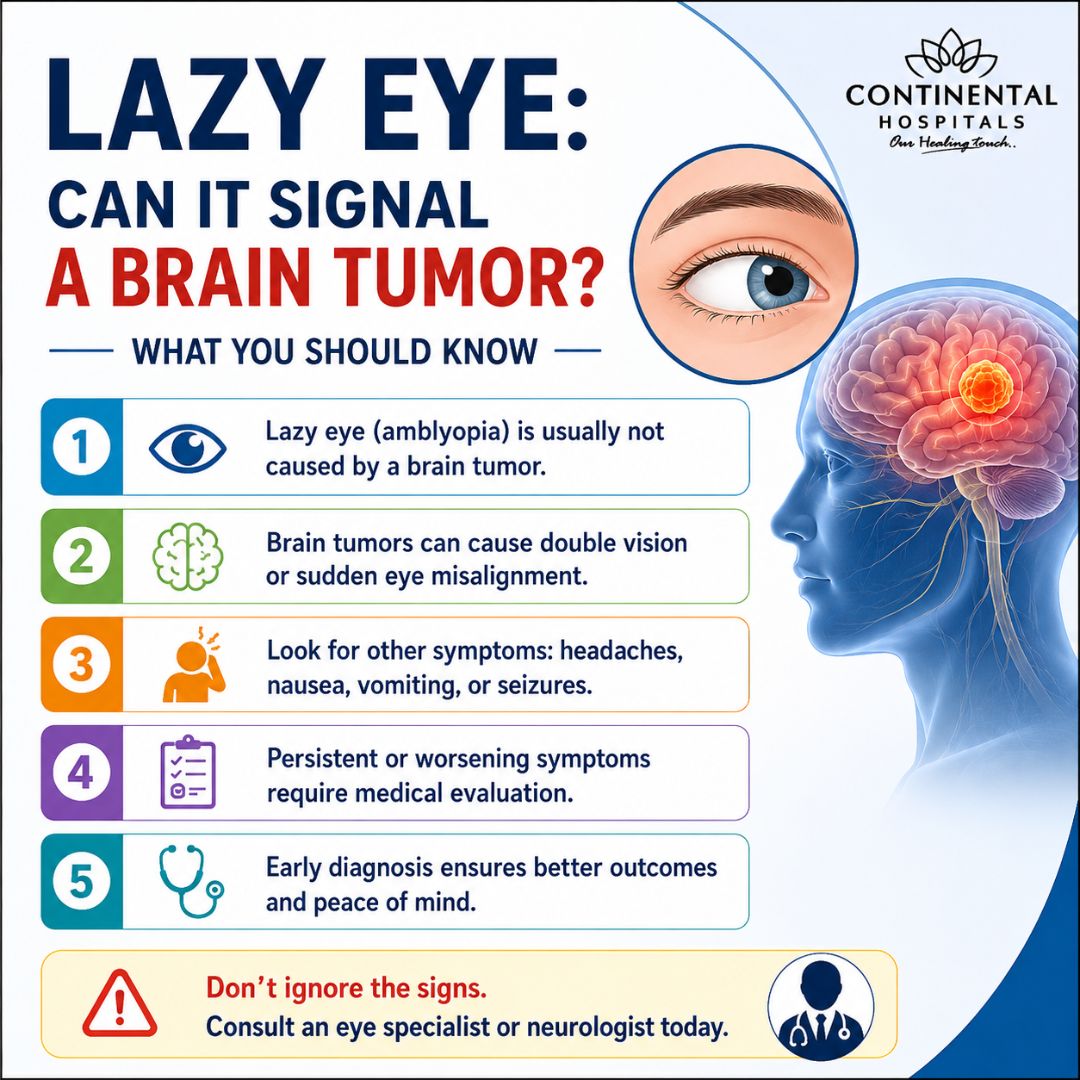
Is there a connection between a lazy eye and a brain tumor?
A brain tumor can affect vision in several ways depending on its size and location. The primary keyword to keep in mind is the relationship between a lazy eye and brain tumor detection.
Pressure on Cranial Nerves: There are twelve pairs of cranial nerves. The third, fourth, and sixth nerves are responsible for eye movement. If a tumor resides near the brainstem or the base of the skull, it can compress these nerves, leading to sudden strabismus.

Increased Intracranial Pressure: As a tumor grows, it takes up space inside the rigid structure of the skull. This increases pressure, which can cause the optic disc to swell (papilledema), leading to blurred vision or a noticeable drift in eye position.
Location Matters: Tumors in the cerebellum or the occipital lobe can disrupt how the brain processes visual information or coordinates muscle movement, resulting in lazy eye symptoms.
What are the common eye symptoms of a brain tumor?
While a lazy eye is a significant indicator, it rarely occurs in total isolation if a brain tumor is the cause. Patients should be vigilant about other brain tumor eye symptoms that may accompany the physical drifting of the eye.
- Double Vision (Diplopia): This is the most common complaint. Because the eyes are no longer aligned, the brain cannot fuse the two images into one.
- Loss of Peripheral Vision: You might feel like you are looking through a tunnel or frequently bump into objects on one side.
- Blurred Vision: Vision that cannot be corrected with a simple change in glasses prescription.
- Involuntary Eye Movements: Also known as nystagmus, where the eye jerks or wiggles uncontrollably.
- Drooping Eyelid (Ptosis): This often occurs alongside a lazy eye if the third cranial nerve is affected.
When should I seek medical advice for a lazy eye?
If you or a loved one notices a change in eye alignment, it is vital to monitor for "red flag" symptoms. You should consult a specialist at the Best hospital in Hyderabad if the lazy eye is accompanied by
- Persistent or worsening headaches, especially in the morning.
- Unexplained nausea or vomiting.
- Seizures or sudden changes in personality.
- Weakness on one side of the body.
- Balance issues or dizziness.
Why Choose Continental Hospitals for Neurological and Eye Care?
When dealing with complex conditions involving the brain and the eyes, the quality of the healthcare institution is paramount. Continental Hospitals is recognized as a leader in multidisciplinary medical care.
World-Class Accreditations
Continental Hospitals stands as a beacon of excellence in the Indian healthcare landscape. It is proud to hold prestigious accreditations including JCI (Joint Commission International) and NABH (National Accreditation Board for Hospitals & Healthcare Providers). These global benchmarks ensure that the hospital adheres to the highest standards of patient safety, clinical protocols, and quality of care. When you seek treatment for a lazy eye and brain tumor concern, these accreditations offer peace of mind that you are in a facility that meets international excellence.
Advanced Diagnostic Technology
Diagnosing the root cause of a lazy eye requires precision. Continental Hospitals is equipped with advanced neuroimaging tools such as high-definition MRI and CT scans that can detect even the smallest lesions in the brain. Our neuro-ophthalmology department works in tandem with our neurosurgery team to provide a comprehensive evaluation.
Integrated Care Model
At Continental, we believe in a patient first approach. Our specialists do not look at symptoms in silos. A patient presenting with a lazy eye will have access to top-rated ophthalmologists, neurologists, and oncologists all under one roof. This integrated model ensures faster diagnosis and a more streamlined path to recovery.
Diagnostic Steps for Lazy Eye in Adults
If you visit a specialist, the diagnostic process usually follows a structured path to rule out or confirm serious causes.
- Comprehensive Eye Exam: The doctor will check visual acuity, depth perception, and muscle function.
- Neurological Screening: Testing reflexes, coordination, and cranial nerve function.
- Imaging: If a neurological cause is suspected, an MRI or CT scan is ordered to visualize the brain and the orbit of the eye.
- Blood Tests: To rule out other conditions like thyroid disease or autoimmune disorders that can cause eye drifting.
Conclusion
A lazy eye might seem like a minor inconvenience, but in the adult population, it is a clinical sign that warrants a deep dive into its origin. While not every case of strabismus points to a brain tumor, the possibility makes early screening essential. Protecting your vision and your neurological health starts with paying attention to these subtle changes. By choosing a facility with the right expertise and global accreditations, you ensure that any underlying condition is managed with the best medical science available today.
If you suffer from sudden double vision, a noticeable drift in your eye, or persistent headaches, do not delay your consultation. Early intervention is the key to successful outcomes in neurological health.
If you are experiencing any of the symptoms mentioned above, please reach out to our experts at Continental Hospitals, the best hospital in Hyderabad. Our team is dedicated to providing you with an accurate diagnosis and a personalized treatment plan. Consult our best neurologist in Hyderabad for a comprehensive evaluation.
Related Blog Topics: