.webp)

Fertility preservation has become an important option for many individuals and couples looking to plan their future families. Two of the most common methods used in fertility preservation are egg freezing and embryo freezing. While these processes might seem similar, they serve different purposes and are suited for different situations. Understanding the differences can help you make informed decisions about your fertility journey.
What is Egg Freezing?
Egg freezing, also known as oocyte cryopreservation, is a process where a woman’s eggs are extracted, frozen, and stored for future use. This option allows women to preserve their fertility before age-related decline or before undergoing medical treatments that may affect fertility, such as chemotherapy.
Key Points About Egg Freezing
- It is ideal for women who want to delay pregnancy for personal or professional reasons.
- No sperm is involved in the process, so eggs are stored unfertilized.
- Eggs can be thawed and fertilized later using IVF when a woman is ready to conceive.
- The egg freezing process usually involves hormonal stimulation, egg retrieval, and cryopreservation.
Visit our Fertility Department at Continental Hospitals, Hyderabad, for expert guidance and advanced treatment options today.
Why consider egg freezing?
- Preserves fertility in women at risk of early ovarian decline.
- Allows flexibility in family planning.
- Can be combined with other fertility treatments if needed.
What is Embryo Freezing?
Embryo freezing, also called embryo cryopreservation, involves fertilizing eggs with sperm to create embryos, which are then frozen and stored for future use. Embryo freezing is commonly used in IVF treatments, where multiple embryos are created to increase the chances of a successful pregnancy.
Key Points About Embryo Freezing
- Embryos are created by fertilizing eggs with sperm before freezing.
- Can be used for both fresh and frozen embryo transfer cycles.
- Offers higher success rates compared to egg freezing because fertilization has already occurred.
- Suitable for couples who have decided on the sperm donor or partner at the time of fertility preservation.
Advantages of embryo freezing
- Higher pregnancy success rates compared to using thawed eggs.
- Useful for patients undergoing IVF who want to store extra embryos for future cycles.
- Allows preimplantation genetic testing for embryo health before transfer.
Egg Freezing vs Embryo Freezing
Understanding the difference between egg freezing and embryo freezing is essential for choosing the right fertility preservation method.

| Feature | Egg Freezing | Embryo Freezing |
|---|---|---|
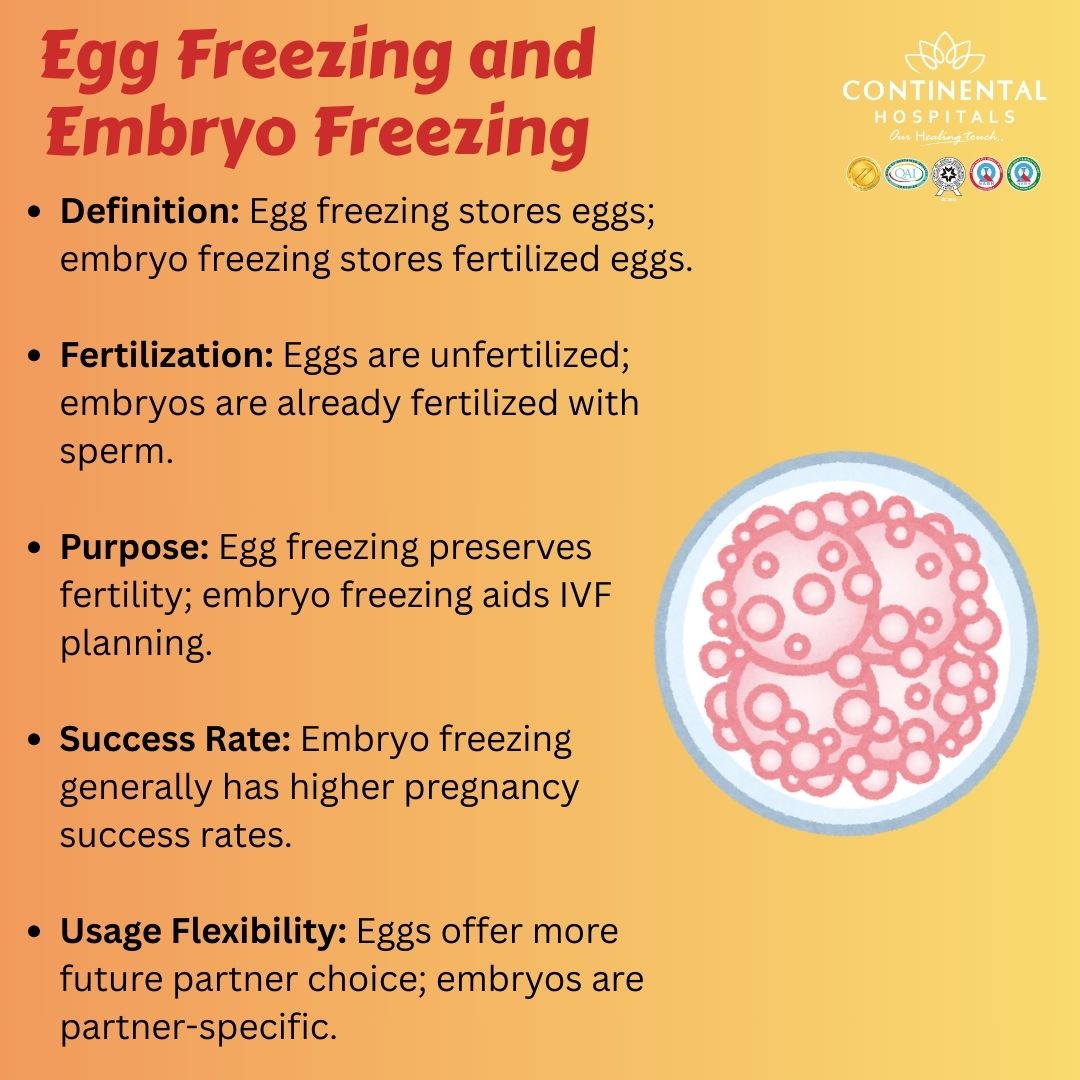
| Fertilization | Eggs are frozen unfertilized | Eggs are fertilized with sperm before freezing |
| Best for | Women delaying pregnancy | Couples or women with a sperm source |
| Success Rate | Slightly lower compared to embryos | Higher pregnancy success due to fertilization |
| Flexibility | Can choose sperm later | Sperm must be available at the time of freezing |
| Ethical Considerations | Eggs remain unfertilized | Embryos are created, which may raise ethical questions for some |
The Egg Freezing Process
The egg freezing procedure involves several steps to ensure eggs are collected safely and stored effectively:
- Ovarian Stimulation: Hormones are given to stimulate multiple eggs to mature in the ovaries.
- Monitoring: Ultrasounds and blood tests track egg development.
- Egg Retrieval: A minor surgical procedure collects the eggs from the ovaries.
- Freezing (Cryopreservation): Eggs are frozen using vitrification for long-term storage.
When the woman is ready to conceive, the eggs can be thawed, fertilized, and implanted through IVF.
The Embryo Freezing Process
Embryo freezing starts with egg retrieval, similar to egg freezing, but includes fertilization before storage:
- Ovarian Stimulation and Egg Retrieval: Same as in egg freezing.
- Fertilization: Eggs are fertilized with sperm to create embryos.
- Embryo Culture: Embryos grow in the lab for a few days.
- Freezing (Cryopreservation): Healthy embryos are frozen for future transfer.
Embryos can later be thawed and transferred to the uterus through a frozen embryo transfer cycle, often leading to successful pregnancies.
Fresh vs Frozen Embryo Transfer
In fertility treatments, there are two options:
- Fresh Embryo Transfer: Embryos are transferred immediately after creation.
- Frozen Embryo Transfer: Embryos are frozen and transferred in a later cycle.
Frozen embryo transfer allows the uterus to recover from ovarian stimulation, improving implantation success and reducing risks.
Choosing Between Egg Freezing and Embryo Freezing
The choice depends on personal, medical, and ethical considerations:
- Age: Younger women may benefit from egg freezing for future fertility.
- Partner Status: Couples or women with a sperm donor may choose embryo freezing.
- Medical Conditions: Women undergoing cancer treatment may opt for either method depending on timing.
- Success Rates: Embryo freezing generally offers higher pregnancy success.
Why Choose Continental Hospitals for Fertility Treatments?
Continental Hospitals in Hyderabad is a trusted center for fertility, IVF, egg freezing, and embryo freezing. Our hospital is accredited and equipped with advanced technology to provide safe and effective fertility treatments.
Reasons to choose Continental Hospitals
- Experienced fertility specialists and IVF experts.
- State-of-the-art IVF lab for egg and embryo freezing.
- Personalized fertility treatment plans for each patient.
- Comprehensive care from consultation to pregnancy follow-up.
- Accredited for high standards in patient safety and care.
Continental Hospitals is committed to offering innovative solutions to help you achieve your dream of parenthood.
Key Benefits of Fertility Preservation
- Provides control over family planning.
- Preserves fertility for women at risk of declining egg quality.
- Increases chances of successful pregnancy through IVF.
- Offers flexible options with frozen eggs or embryos.
Quick Points Summary
- Egg freezing stores unfertilized eggs for future use.
- Embryo freezing stores fertilized embryos for IVF cycles.
- Embryo freezing has higher success rates than egg freezing.
- Fresh vs frozen embryo transfer affects pregnancy outcomes.
- Continental Hospitals offers advanced fertility treatments with expert care.
Conclusion
Both egg freezing and embryo freezing are effective ways to preserve fertility, but the choice depends on your personal situation, medical needs, and future plans. Understanding the differences ensures you make the right decision for your reproductive health.
If you are considering egg freezing or embryo freezing, consult a qualified fertility specialist to guide you through the process. At Continental Hospitals, our team of experts provides compassionate care, advanced technology, and personalized fertility solutions to help you achieve your dream of starting or growing your family.
Consult our best fertility specialists at Continental Hospitals, Hyderabad, for expert guidance and advanced treatment options today
Related Blog Topics: