.webp)

The global conversation about the 2026 Ebola outbreak has been intense in recent weeks. With news of new Ebola cases jumping across parts of Africa, people worldwide are asking: Is the Ebola virus spreading again? While Ebola cases are being contained, global health officials are actively encouraging the public to stay up-to-date with the latest Ebola news today and to sound the alarm on updating and taking preventive steps to help reduce transmission.
The Ebola outbreak doesn't get much more attention than the other outbreaks of infectious diseases due to its high mortality rate and its mode of transmission, which spreads quickly from person to person via direct contact with infected body fluids. Though improvements have been made in the response to Ebola outbreaks over the past decades, healthcare workers have developed strategies to improve surveillance and early detection, as well as immunization of people at risk of exposure and better emergency response systems. In addition, public awareness has helped people seek medical treatment promptly, which has also helped to curb the spread of the disease.
The latest Ebola news today shows that health authorities are ramping up monitoring on the disease, strengthening screening at borders, and boosting community outreach programs in affected areas. At this time, there is little evidence of widespread transmission of Ebola virus disease, but the outbreak underscores the importance of staying up-to-date with the latest ebola news today and with public health warnings.
What Is Ebola Virus Disease?
Ebola virus disease (EVD) is a rare but severe disease that occurs when a person is infected with the Ebola virus. The virus spreads from person to person through direct contact with infected community members’ blood, secretions, organs, or body fluids.
The first Ebola outbreak was detected in 1976 in a village near the Ebola River in Central Africa. Since then, there have been several outbreaks of varying severity.
To know more about Ebola Virus Disease and advanced infection care, visit the Infectious Disease Department at Continental Hospitals. Our expert team provides comprehensive diagnosis, isolation care, and personalized treatment for complex infectious diseases.
What Are the New Ebola Updates in 2026?
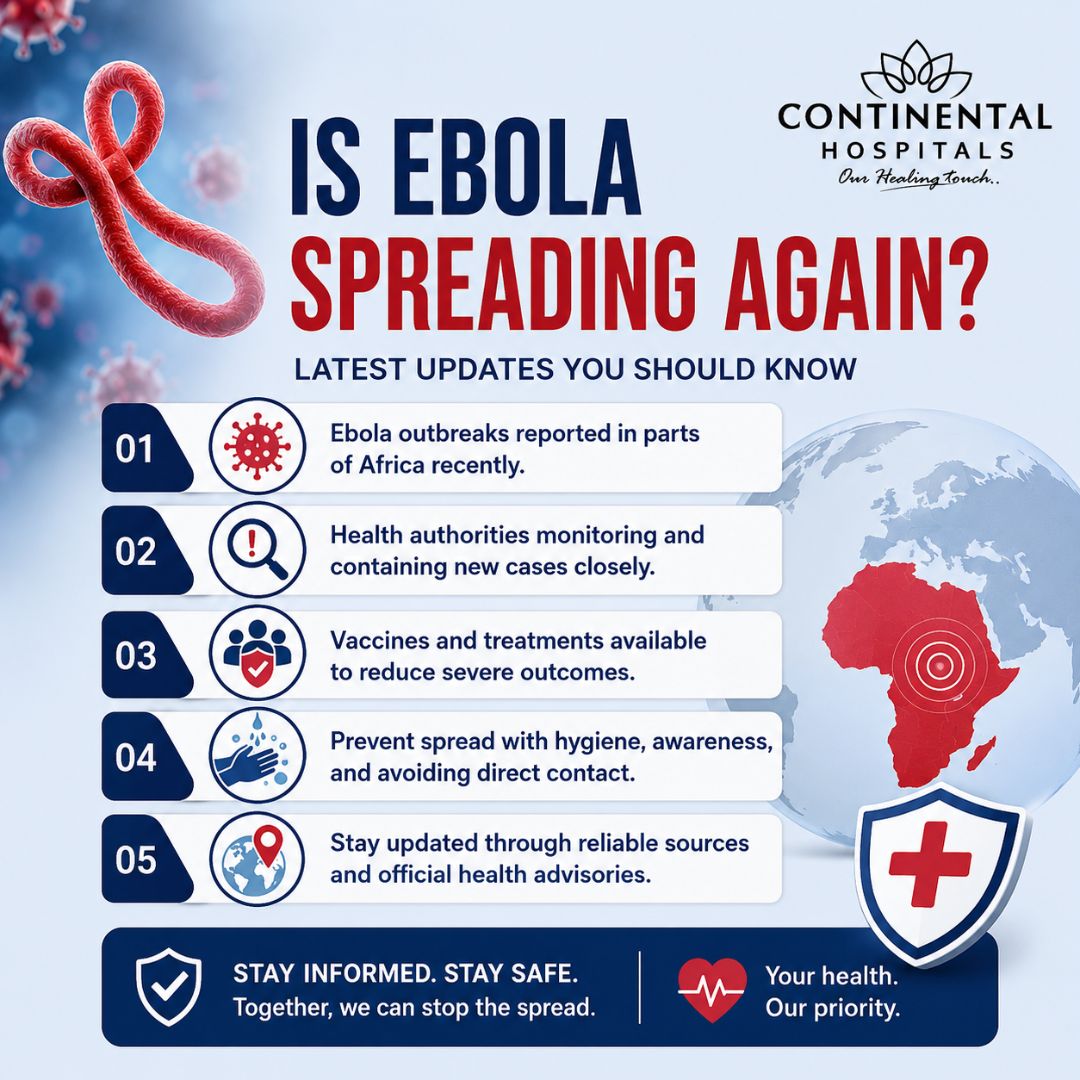
Latest Ebola updates show that authorities are most closely watching isolated clusters of infection. Rapid response teams are active on the scenes, carrying out tests, detecting contacts, isolation and vaccination to contain the outbreak fast.
Present efforts worldwide are as follows:
- Airport and border screening protocols
- Disease surveillance system upgraded
- Hospital emergency preparedness
- Public information campaign
- Vaccination for vulnerable groups
Although experts will avoid exhalation in the Ebola global health emergency situation, health worldwide agencies say early detection and coordinated action are avoiding the global risk.

What are the Ebola virus symptoms?
Ebola symptoms tend to appear suddenly in the human being and may become worse at the same time. Early symptoms of Ebola are usually like a viral infection, so an early diagnosis is required.
Some of the symptoms of Ebola are the following:
- High fever
- Severe weakness and lethargy
- Headache
- Muscle aches and pains
- Sore throat
- Vomiting, diarrhea
- Abdominal ache
- Bleeding and bruising not caused by causes
In severe cases, the patient may suffer from internal bleeding, organ failure, and shock.
What Is the Ebola Outbreak Caused by?
The Ebola virus outbreak is caused by direct transmission of the Ebola virus mainly from human to human or from infected animals to humans.
The Ebola virus can be transmitted by:
- Direct contact with infected fluids
- Contact with contaminated bodies
- Contact with infected animals
- Unhygienic burial
- Contact with patients through lack of protection in healthcare settings
It is not an airborne virus, and it cannot be spread by touch or in air.
Which Populations Are More at Risk of Ebola Infection?
Some populations are at greater risk during an outbreak, including:
- Health care personnel
- Caregivers in the patients’ households
- Laboratory staff
- Individuals traveling to the outbreak area
- Those exposed to infected wildlife
Infection risk can be substantially reduced by being aware of your risk and taking preventive measures.
What Is The Diagnosis For Ebola Virus Disease?
Doctors diagnose Ebola virus disease by clinically assessing the patient, considering travel history and potential exposures, and by laboratory testing.
Potential laboratory tests include:
- Blood tests
- PCR testing
- Antigen tests
- Antibody testing
Early diagnosis can improve isolation protocols and support care measures.
What Treatments Exist for Ebola?
There is no one universal cure for ebola, but supportive care significantly increases survival rates.
Supportive care includes:
- Intravenous fluids and hydration
- Oxygen support
- Blood pressure support
- Secondarily infected microorganisms
- Pain and fever management
- Experimental antiviral therapies
- Monoclonal antibody-based therapies
Patients are more likely to recover with early intensive care in a medical center specialized in advanced treatment.
How to Stop Ebola?
Stopping Ebola calls for precautions by individuals and rigorous public health measures. Preventive measures include:
- Do not touch infected persons
- wash your hands often
- wear personal protective devices
- do not touch dead animals in outbreak areas
- adopt safe burial practices
- seek vaccination (if advised)
- seek medical attention when exposed
Everyone’s cooperation is needed to tackle the Ebola outbreak of 2026 and prevent more Ebola cases.
What lifestyle advice is important during an ebola outbreak?
Good hygiene habits and up-to-date information help reduce fear and risk during outbreaks.
- Going by reliable health advice, avoid fake news on social media
- keep yourself clean
- eat healthy to support your immunity
- Stay hydrated and well-rested.
- do not travel without need to affected areas
- go to doctor quickly when ill
Be calm and know what to do in an Ebola global health emergency.
When to Go to the Doctor?
You should seek immediate medical care if you
- develop a fever after traveling from the affected area
- have an unexplained bleeding
- have contact with an infected individual.
- develop sudden extreme weakness.
- vomit after exposure to bodily fluids
Early management of medical care can prevent complications and reduce the spread of infection.
Why Continental Hospitals Are Best for the Treatment of Ebola Virus Disease?
At Continental Hospitals, we aspire to treat you with the best infectious disease care with a focus on safety and advanced multidisciplinary treatment technology.
Some reasons why patients go to Continental Hospitals:
- Infectious disease experts
- Advanced diagnostic and monitoring technology
- Multidisciplinary critical care
- Personalized care plans
- JCI-accredited healthcare standards
- NABH Accredited excellence in patient safety
- Cutting edge infrastructure
- 24x7 emergency and critical care services
- High standards of patient care and infection control
Our expert medical teams provide prompt diagnosis and isolation management, intensive care support and superhuman recovery management for infectious diseases.
Conclusion
The possibility of Ebola spreading again and the growing fear caused by such a possibility are concerning. Though the current ebola news today indicates that health authorities are managing the situation, people should be aware and take appropriate precautions. Prompt diagnosis and treatment and the role of healthcare systems would continue to be crucial in controlling the spread of Ebola infection and protecting our communities.
To know more about Ebola Virus Disease, please consult our best infectious disease specialists in Hyderabad at Continental Hospitals. For the best care, including specialist diagnosis and treatment, visit Continental Hospitals.
Related Blog Topics: